Houmam Saad and Komait Abdallah have been invited by Professor Jean-Luc Fournet, holder of the Chair in Written Culture in Late Antiquity and Byzantine Papyrology.
Abstract
Discovered in 2017 during clandestine excavations in Al-Rastan, in central Syria, a monumental 4th-century A.D. mosaic was the subject of a rescue operation and systematic excavation by the General Directorate of Antiquities and Museums (DGAM) between 2022 and 2023. Urban planning constraints required the excavation of a tunnel beneath the modern roadway in order to fully uncover this masterpiece.
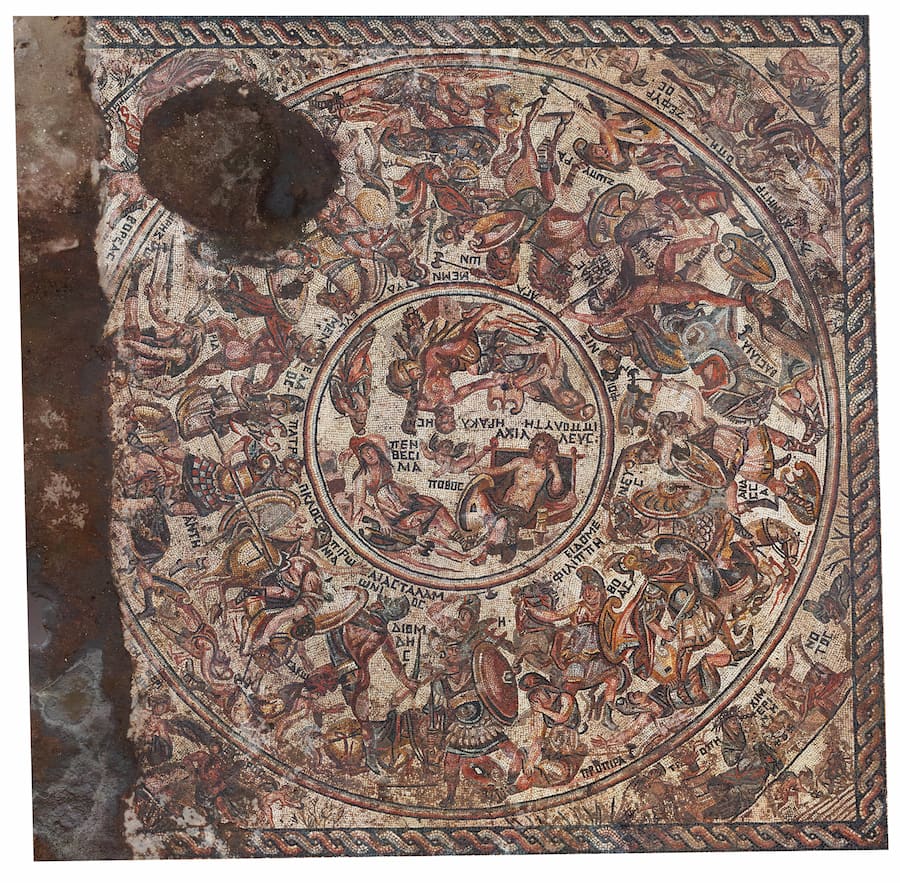
The floor, of exceptional iconographic richness, consists of a main geometric pattern and three figurative panels: the triumphal procession of Poseidon and Amymone, a circularly composed Amazonomachy, and a Centauromachy.
The panel depicting Poseidon and Amymone stands out for its marine thiase featuring Nereids identified by inscriptions, several of which were previously unknown in the repertoire of ancient art. The Battle of the Amazons is characterized by an axial composition highlighting the deified figures of Achilles and Heracles, victorious over the two famous Amazon queens, Penthesilea and Hippolyta. Along the periphery unfolds an original composition depicting the clash between ten heroes of the Trojan War and ten Amazons. Finally, the Centauromachy panel depicts the Centaurs’ battle against the Lapiths on the one hand, and their confrontation with wild beasts on the other.
The major scientific significance of this pavement lies in the systematic presence of Greek nominative lemmas above each figure, both in the Amazonomachy and in the Centauromachy. This epigraphic corpus not only allows for the identification of rarely depicted heroes (such as Idomeneus or Thoas), but also provides a list of Amazon names ( Piroina, Sdko, Zobira, Aria, Anthea ) not documented in ancient literary or figurative sources. This iconographic and textual corpus constitutes an exceptional testament to the level of mythological erudition and paideia among the elite patrons in the Roman province of Syria.
