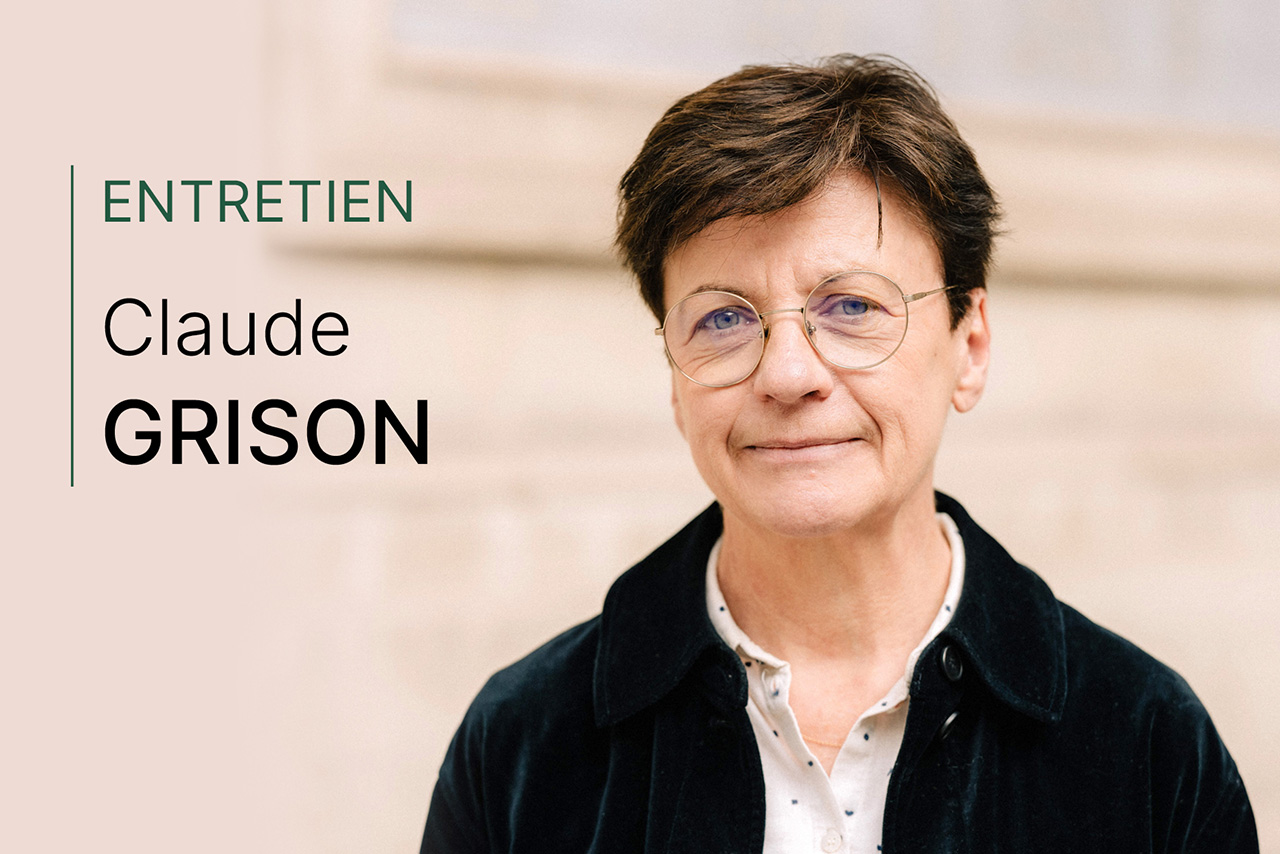
As both a biochemist and an ecologist, Claude Grison breaks down the barriers between disciplines. Her work on plants capable of bioconcentrating metallic and organic pollutants is carried out within a framework of sustainable chemistry, and enables the restoration of severely degraded ecosystems whilst recycling polluting metals, such as manganese and palladium, into eco-catalysts.
She has been invited to hold the Avenir Commun Durable Annual Chair for the 2025–2026 academic year, which is supported by the Collège de France Foundation and its major patrons, the Covéa Foundation and TotalEnergies.
How did your interest in science – and chemistry in particular – first come about?
Claude Grison: I have a naturally curious mind, which drew me towards science in general – from geography to chemistry, and from philosophy to ecology. What interests me is the overarching coherence of science, which enables me to answer an extremely wide range of questions. I prefer an interdisciplinary approach to the fragmentation of knowledge, so I found it difficult to choose a single discipline during my studies. I opted for biochemistry – a term I prefer to ‘organic chemistry’ – because it is a frontier discipline; a non-choice, in short. In this field, one inevitably takes an interest in other areas, such as biology and ecology. It’s a question of scale, but we’re studying the same living organisms, and we need physical tools, which are themselves closely linked to mathematics. The questions we ask as researchers are also intrinsically linked to philosophical concepts, such as taking a step back and questioning our assumptions. Finally, as I like my work to be useful, I’m interested in economics.
After your early work on bacterial resistance, you eventually turned your research towards ecology – what prompted this transition?
After becoming a professor in 1995, I was sent by the CNRS to co-direct the Laboratory of Biomolecular Organic Chemistry at the University of Montpellier in 2003, where the scientific environment was very different from the one in Nancy that I had come from. There, I discovered significant scientific expertise in the field of ecology. Around 2008, as part of my teaching duties, four young female students asked me for help with a topic they were preparing for an entrance exam to the prestigious engineering schools. They had chosen a question that was very novel at the time: can plants be used to clean up pollution? I didn’t know much about it, but their enthusiasm won me over, so I did some research, pored over the scientific literature and we worked together on the question. That’s when I discovered a fascinating plant, the blue stool ( Noccaea caerulescens ), which had been studied for several years by the ecologist José Escarré. This plant managed to thrive on a heavily polluted mining site near Montpellier, a place hostile to all other vegetation – a true anomaly of nature. Better still, it extracted a metallic element from the soil – zinc – and stored it in its leaves, as if to protect itself! I saw this as an absolutely brilliant response from nature, and a far more interesting alternative to the usual methods of soil decontamination, such as excavating the soil or using chemical treatments. However, the Interministerial Centre for the Prospective Analysis of Economic Change was already warning at the time about the critical state of mineral resources, such as zinc. For me, that was a real eye-opener. We had right before our eyes a plant that served a dual purpose: extracting a precious mineral resource whilst restoring the soil, thereby enabling a return to the site’s original biodiversity. And the resulting plant material is not contaminated waste, but a usable natural resource.
What applications can you envisage from this?
I thought about a viable business model. How much land would be needed to generate a profit large enough to support the large-scale development of this plant? Using it to produce metallic zinc made no sense, as it would have required an enormous amount of land. That’s where my background as a chemist made all the difference. In chemistry, we use catalysts to initiate, accelerate or optimise certain reactions involving millions of molecules. Zinc catalysts fall into this category; you can use very little zinc to produce a large number of molecules. It was to pursue this idea that I joined the Centre for Functional and Evolutionary Ecology in Montpellier, where I was the only chemist! After a year, the first results were in. My zinc-loaded blue-stool leaves were catalysing a chemical reaction. Shortly afterwards, I travelled to New Caledonia, a global biodiversity hotspot, to restore mining sites using local plants. I use the term ‘restoration’ because the notion of total decontamination is rather naïve. Our aim is not to eradicate every pollutant; we want to restore nature to its rightful state and re-establish the original biodiversity of polluted sites. These areas, which were once barren and hostile, have now turned green again: the young plants we planted there over ten years ago are now nearly two metres tall. And many local plants have reappeared. Furthermore, the catalysts we have produced are sometimes even more effective than those derived from metallurgy, and we have discovered entirely new catalyst structures. I then turned my attention to water pollution. By using certain invasive aquatic plants – which are a real scourge for biodiversity – and grinding them into a powder, we realised that we could recover strategic metals from the water. Palladium, for example, which is in short supply in France and whose main global producer is Russia. Yet it is an essential metal in the automotive and electronics industries, as well as for the production of one in three medicines in pharmaceutical chemistry. Today, I am developing the large-scale harvesting of these invasive plants, following an ecological protocol that allows us to measure the benefits we bring to biodiversity and the production of precious resources. These are non-traditional ways of thinking, but we must challenge the reflexes of a linear economy and develop the logic of truly sustainable chemistry, where economic, ecological, social and environmental considerations are in harmony.
How does this sustainable chemistry differ from what is known as green chemistry?
Green chemistry is based on principles aimed at reducing the impact of chemical processes. This is useful, but insufficient. Sustainable chemistry inspires me more, as it draws on the pillars of sustainable development to solve past, present and future environmental problems. Green chemistry does not seek to solve these problems, but rather to prevent those that might arise. So how do we solve the problems that have already been identified? Moreover, it overlooks the socio-economic aspect of the proposed solutions. Without this aspect, your solutions may be as virtuous or effective as possible, but nobody will develop them.
As the only chemist in a laboratory of ecologists, how did this interdisciplinary approach affect you?
The director of this laboratory, who was a mathematician, felt that certain areas of ecology were precisely lacking in chemistry. I provided the ecologists with a skill they lacked, and they taught me the knowledge I was missing. Faced with a plant capable of accumulating pollutants within itself, the ecologist asks, ‘Why?’, whilst the chemist asks, ‘How?’ Two equally important questions, the complementary answers to which enabled me to develop the various ecological restoration projects I have led. Throughout this collaboration, I have broken down the artificial barriers that are sometimes erected between scientific disciplines. The CNRS then invited me to set up the Laboratory of Bio-inspired Chemistry and Ecological Innovation, which I currently head, with this interdisciplinary approach extending right up to the management level. People no longer know how to categorise me. Am I a chemist or an ecologist? I consider myself an eco-chemist. Today, one cannot be conceived without the other. Ecology is the starting point for innovation, and chemistry brings an economic dimension to it, which in turn supports ecological solutions.
What were the main difficulties you encountered whilst working on this project?
Prejudices – such as the notion that chemistry and ecology are incompatible – which stem from a deeply entrenched monodisciplinary culture. However, rethinking things differently is extremely difficult: some people remain very hostile to these new ideas on principle, and it is impossible to have a conversation with them. This obstacle has manifested itself at every level: funding, publications, the general public… Fortunately, I have also met some extraordinary people who have helped me enormously. Moreover, my motivation lies in the practical value of my research. I want to be a researcher who is also a citizen; I want to make progress and prove, through my results, that a different approach based on sustainable development is possible. I am also delighted to see an absolutely exceptional enthusiasm amongst young chemists and ecologists.
In 2025, you will take up the Avenir Commun Durable Chair at the Collège de France. What does this mean to you, and what are your expectations?
This appointment is a source of pride for the cause I champion – namely, the interdisciplinary approach between ecology and chemistry – and I am very grateful for it. At present, my research takes up a considerable amount of my time, but the chair will enable me to engage with the public and share my work; a real pleasure when you’re a professor. And the Collège de France is very open, welcoming all kinds of people curious about science, regardless of their educational background. I’m looking forward to all the lectures and discussions that lie ahead, such as the day of discussions with sixth-formers that I’ve organised and which is very close to my heart. I’ve set them a challenge: can chemistry be environmentally friendly? We’ll be exploring this question together. Another interesting aspect is that I can invite people from a variety of backgrounds who develop ideas that complement my own. We’ll be discussing fundamental issues and technical findings with these guests and the audience, as well as the underlying philosophy and thinking behind them. And this is an absolutely wonderful opportunity.
Interview by William Rowe-Pirra, science journalist