CIRB
CENTRAL NEUROPEPTIDES IN THE REGULATION OF BODY FLUID HOMEOSTASIS AND CARDIOVASCULAR FUNCTIONS
Director : Catherine LLORENS-CORTES
THE BRAIN RENIN-ANGIOTENSIN SYSTEM (RAS)
We showed in the brain RAS that aminopeptidase A (APA) is implicated in the conversion of angiotensin II (AngII) to AngIII. Then, in collaboration with the team of B.P Roques (U640), we designed the first specific and selective APA inhibitor, EC33. Using this compound, we showed that brain AngIII and not AngII, as established in the periphery, exerts a tonic stimulatory effect on the control of blood pressure (BP) in hypertensive animals (1 patent). Therefore, the inhibition of brain APA, while blocking the formation of brain AngIII, decreases BP. Thus, brain APA might constitute an interesting candidate therapeutic target for the treatment of certain forms of hypertension (HTA). Our work was then to develop a new antihypertensive agent with a mode of action different from those used to date. For this purpose, we produced with the team of B.P Roques a new potent and selective APA inhibitor, RB150 (1 patent) able, after administration by oral route, to cross the intestinal, hepatic and blood brain barriers, to block the activity of the brain RAS and to normalize BP in hypertensive rats. We pursue this project, in order to assess and compare to clinical standards, the antihypertensive efficacy of both acute and chronic administrations of RB150 in several animal models :
(1) in hypertensive DOCA-salt rats which are characterized by low plasma renin activity and a resistance to systemic RAS blockers treatments,
(2) in spontaneously hypertensive rats (SHR) which are considered to be a relevant model of essential hypertension sensitive to systemic RAS blockers. Moreover, the antihypertensive effects of RB150 administered in combination with different antihypertensive drugs will be assessed in the same rodent models. We will also study the side-effects of acute and chronic administrations of RB150 on the activities of the vasopressinergic system, the systemic renin-angiotensin-aldosterone system and the cholecystokinin-8 (CCK8) system since brain CCK8 is metabolized in vivo by APA. For a potential clinical use of RB150, we will define the biochemical and enzymatic properties of APA in the human brain, especially its sensitivity to EC33, together with its brain distribution. The collaboration with Quantum Genomics Society will facilitate evaluation of the bioavailability, genotoxicity and toxicity of RB150 in animals. Finally, if RB150 obtained the required authorisations, the clinical work will be conducted under the supervision of Pr. M. Azizi (APHP/CIC 9201, Hôpital Européen Georges Pompidou).
THE APELINERGIC SYSTEM
Our efforts to clone an AngIII receptor led to isolate in the rat brain, an orphan receptor which was subsequently shown to be the receptor of a new peptide, apelin. We demonstrated that apelin and its receptor were expressed together with vasopressin (AVP) in magnocellular hypothalamic neurons. We showed that the icv injection of apelin in lactating rats decreased the phasic electrical activity of these neurons and the secretion of AVP into the bloodstream, increasing aqueous diuresis. Apelin, is thus a natural inhibitor of the anti-diuretic effects of AVP. Finally, in rats and humans, we found that apelin and AVP are regulated in opposite manners by osmotic stimuli, thereby both participating to the maintenance of body fluid homeostasis. Apelin and its receptor are also present in the heart, kidney and blood vessels and the systemic injection of apelin decreases arterial blood pressure, improves cardiac contractility and reduces cardiac loading. Apelin may therefore be involved in controlling cardiovascular functions. No non-peptide agonist or antagonist of the apelin receptor has been yet discovered. Our aim is to obtain such compounds, making it possible to explore the role played by this peptide further upstream in cardiovascular diseases and water retention and/or hyponatremic disorders. In collaboration with B. Maigret (CNRS UMR7503, LORIA), M. Hibert and J.J Bourguignon (CNRS UMR7175, Institut Gilbert Laustriat Biomolécules, Biotechnologie, Innovation Thérapeutique), our project aims to:
1) Investigate the structure-function relationships of apelin and its receptor by molecular modelling and site-directed mutagenesis studies allowing identification of the structural requirements for binding of apelin to its receptor and for the subsequent signaling pathways activation;
2) Optimize the first partial agonist E339-3D6 we have previously identified (1 patent);
3) Perform Medium Throughput Screening of diverse and drug-like libraries by FRET and to validate the hits by binding studies;
4) Design virtual small focalized and cation-containing libraries for “in silico” screening;
5) Synthesize and evaluate the affinity of the hits (selected from the “in silico” screening by binding studies); 6) Optimize the best hits obtained in the different screenings;
7) Determine the pharmacological profile of the selected compounds, in vitro, ex vivo and in vivo in the brain, heart and kidney.
We hope to discover a nonpeptidic agonist of the apelin receptor, the optimization of its structure towards a compound meeting the clinical candidate status requirements will allow to develop new potent compounds useful for the treatment of cardiovascular diseases.
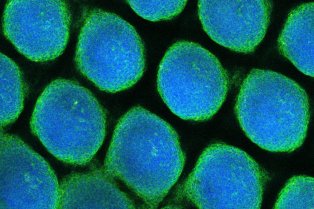
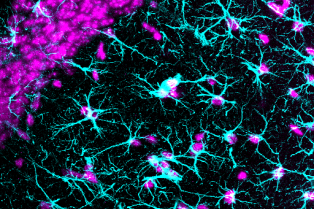
Confocal images of magnocellular neurons double-labeled with antisera against apelin and AVP in lactating rats.
SCIENTIFIC PROJECTIONS
20% of the population suffers from HTA. HTA is a major risk factor for many diseases, including coronary disease, cerebral vascular accidents, heart and renal failure, and this has resulted in the development of many families of drugs for treatment. However, HTA remains difficult to control. Current monotherapies are insufficient in more than half of all cases and individual responses to a given compound are highly variable. Moreover, some cases of HTA are resistant to classical treatment of inhibitors of the systemic RAS, notably HTA in African Americans. This underlines the importance to develop new antihypertensive agents such APA inhibitors (powerful and selective and capable of crossing the intestinal, hepatic and blood-brain barriers following oral administration) with a mode of action different from those used to date, adaptable to the type of hypertension. The work in this program will be pursued in collaboration with Quantum Genomics and BP. Roques, to complete the preclinical development of RB150 and to develop new molecules capable of replacing RB150 if this molecule does not meet all the necessary criteria for clinical trial. If RB150 obtains the required authorisations, this will allow (1) to assess through several phase I trials in healthy volunteers the safety, the tolerability, the pharmacokinetics, the early pharmacodynamics and the dosing requirements of RB150 treatments and (2) to assess pharmacodynamic biomarkers in sodium-depleted and sodium-replete subjects. Successful completion of this project will allow the initiation of a Phase IIa pilot trial in hypertensive patients. All of this research, which first began in 1993, should lead to the development of a new antihypertensive drug.
Our work and studies of other laboratories has shown the beneficial role of apelin in controlling body fluid homeostasis and cardiovascular functions, this suggests that the apelin receptor could constitute a potential therapeutic target for the treatment of cardiovascular diseases and water retention and/or hyponatremic disorders. The aim of our project in collaboration with B. Maigret for modeling studies and with M. Hibert and JJ. Bourguignon for chemistry is to develop nonpeptidic agonists or antagonists of the apelin receptor which do not exist to date. Apelin, like most endogenous peptide ligands, is rapidly metabolized, non-peptidic bioavailable agonists and antagonists would represent much better tools to explore both in vitro and in vivo the different physiopathological functions mediated by apelin. A nonpeptidic agonist of the apelin receptor would be particularly useful for the treatment of heart failure by favouring aqueous diuresis and improving the contractile performance of the myocardium whilst decreasing peripheral resistances.
SELECTED PUBLICATIONS 2004-2009
- Fournie-Zaluski M.-C., Fassot C., Valentin B., Djordjijevic D., Reaux-Le Gaozigo A., Corvol P., Roques B.P & Llorens-Cortes C. (2004), Brain renin-angiotensin system blockade by systemically active aminopeptidase A inhibitors: a potential treatment of salt-dependent hypertension. Proc Natl Acad Sci, USA, 101(20): 7775-80.
- De Mota N., Reaux-Le Goazigo A., El Messari S., Chartrel N., Roesch D., Dujardin C., Kordon C., Vaudry H., Moos F. & Llorens-Cortes C. (2004), Apelin, a potent diuretic neuropeptide counteracting vasopressin actions through inhibition of vasopressin neuron activity and vasopressin release. Proc Natl Acad Sci, USA, 101(28): 10464-9.
- Rozenfeld R., Muller L., El Messari S. & Llorens-Cortes C. (2004), The C-terminal domain of aminopeptidase A is an intramolecular chaperone required for the correct folding, cell surface expression and activity of this monozinc aminopeptidase. J Biol Chem, 279(41): 43285-95.
- Reaux-Le Goazigo A., Morinville A., Burlet A., Llorens-Cortes C. & Beaudet A. (2004), Dehydration-induced cross-regulation of apelin and vasopressin immunoreactivity levels in magnocellular hypothalamic neurons. Endocrinology, 145(9) : 4392-400.
- Chartrel N., Alvear-Perez R., Leprince J., Iturrioz X., Reaux-Le Goazigo A., Audinot V., Chomarat P., Coge F., Nosjean O., Rodriguez M., Galizzi Jp, Boutin Ja., Vaudry H. & Llorens-Cortes C. (2007), Comment on "obestatin, a peptide encoded by the ghrelin gene, opposes ghrelin's effects on food intake. Science, 315(5813): 766.
- Reaux-Le Goazigo A., Alvear-Perez R., Zizzari P., Epelbaum J., Bluet-Pajot Mt., Llorens-Cortes C. (2007), Cellular localization of apelin and its receptor in the anterior pituitary: evidence for a direct stimulatory action of apelin on ACTH release. Am J Physiol Endocrinol Metab, 292(1) : E7-15.
- Azizi M., Iturrioz X., Blanchard A., Peyrard S., De Mota N., Chartrel N., Vaudry H., Corvol P. & Llorens-Cortes C. (2008), Reciprocal regulation of plasma apelin and vasopressin by osmotic stimuli. J Am Soc Nephrol, 19(5): 1015-24.
- Bodineau L., Frugiere A., Marc Y., Inguimbert N., Fassot C., Roques B. & Llorens-Cortes C. (2008), Orally active aminopeptidase A inhibitors reduce blood pressure by inhibiting the brain-renin-angiotensin system: a new strategy for treating hypertension. Hypertension, 51(5): 1318-25.
- Hus-Citharel A., Bouby N., Frugiere A., Bodineau L., Gasc Jm. & Llorens-Cortes C. (2008), Effect of apelin on glomerular hemodynamic function in the rat kidney. Kidney Int; 74(4): 486-94.
- De Mota N., Iturrioz X., Claperon C., Bodineau L., Fassot C., Roques Bp., Palkovits M. & Llorens-Cortes C. (2008), Human brain aminopeptidase A: biochemical properties and distribution in brain nuclei. J. Neurochem, 106(1): 416-28.
- Claperon C., Banegas-Font I., Iturrioz X., Rozenfeld R., Maigret B. & Llorens-Cortes C. (2009), Identification of threonine 348 as a residue involved in aminopeptidase A substrate specificity. J Biol Chem, 284(16): 10618-26.
- Iturrioz X., Alvear-Perez R., De Mota N., Franchet C., Guillier F., Leroux V., Dabire H., Le Jouan M., Chabane H., Gerbier R., Bonnet D., Berdeaux A., Maigret B., Galzi Jl., Hibert M. & Llorens-Cortes C. (2009), Identification and pharmacological properties of E339-3D6, the first nonpeptidic apelin receptor agonist. FASEB J., Dec 29.
INVITATIONS AND SEMINARS
2004 : Gordon Research Conference On Angiotensin, Ventura – USA.
2005 : American Physiological Society Conference – Steamboat Springs, Colorado, USA.
2006 : 6th International Congress of Neuroendocrinology. J. Benoit Lecture. Pittsburgh, USA.
2007 : Lilly 2007, Genesis Investigator Meeting, Paris, France.
VIIth World Congress on Neurohypophysial Hormones, Regensburg, Germany.
2008 : Seminar of the Chair of Experimental Medicine organized by Pr P. Corvol & C. Llorens-Cortes entitled “New Data on G-Protein Coupled Receptors”, Collège de France, Paris, France.
2009 : Joint Meeting Peptide Receptor/Kinin 2009, Quebec, Canada.
XVIIIth Scientific Meeting of the Inter-American Society of Hypertension and Renin Angiontensin Aldosterone System Satellite Belo Horizonte, Brazil.
2010 : The 7th International Congress of Neuroendocrinology Rouen, France: member of the International Program Organizing Committee.
PEOPLE
Director :
Llorens-Cortes Catherine, DR1 INSERM
Senior Researchers :
Iturrioz Xavier, CR1 INSERM
Maigret Bernard, DRE CNRS
Technical staff :
Alvear-Perez Rodrigo, IE INSERM
Hus-Citharel Annette, IE CDF
Picco-De Mota Nadia, TCH CDF
Post-docs and Students :
Galanth Cécile, post-doc
Gao-Desliens Ji, post-doc
Li Bo, Post-doc
Gerbier Romain, PhD student Paris Descartes
Ceraudo Emilie, post-doc
Pouchelon Clara, Master 1
Aboukhamis Hani, Master 2