
Presentation
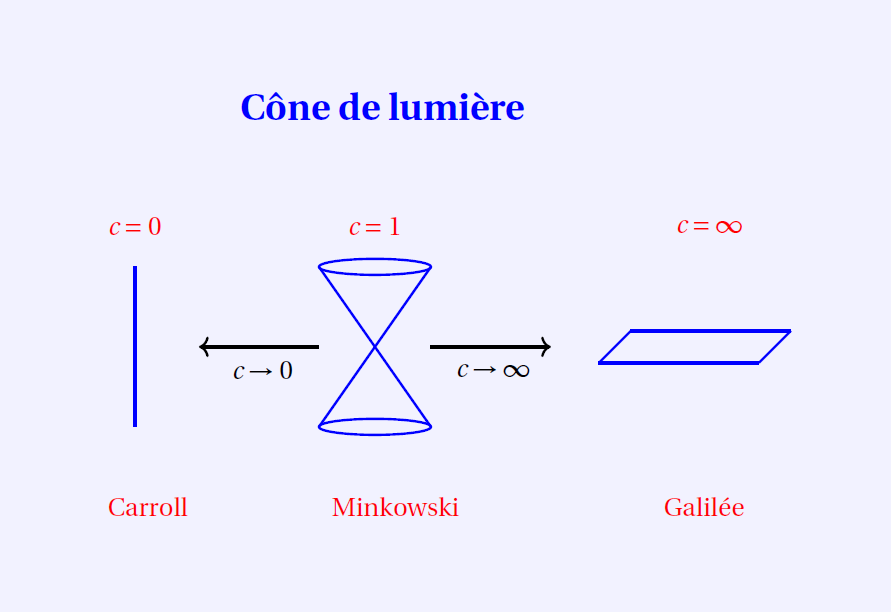
The non-relativistic limits of Einstein's theory - also known as non-Lorentzian limits - are obtained by tending the speed of light c towards infinity (Galilean limit) or towards zero (Carrollian limit). The Poincaré group of special relativity is thus replaced by the Galilean group or the Carroll group.
Non-Lorentzian theories are based on geometric and algebraic structures of great interest. They also have many applications, from holography for asymptotically flat spaces to the study of certain models of condensed matter, via zero-tension strings, cosmology and the physics of zero hypersurfaces in general relativity (examples of which are the horizons of black holes or the infinity of light)
The 2025-2026 lecture will build up the non-relativistic limits of Einstein's theory, study its mathematical properties and cover some applications. The lecture itself will focus on theoretical aspects, while the seminars will focus on recent applications.
The lecture will take place on Wednesdays from 2:00 p.m. to 3:30 p.m., followed by the seminar from 4:00 p.m. to 5:30 p.m. (except on 10 June, when two classes will be held back-to-back).