
Access conditions
Due to large numbers, we recommend that all members of the public arrive at least 45 minutes before the start of the event. Seats cannot be reserved, and are allocated on a first-come, first-served basis only. If capacity is reached, the public may be directed to a broadcast room.
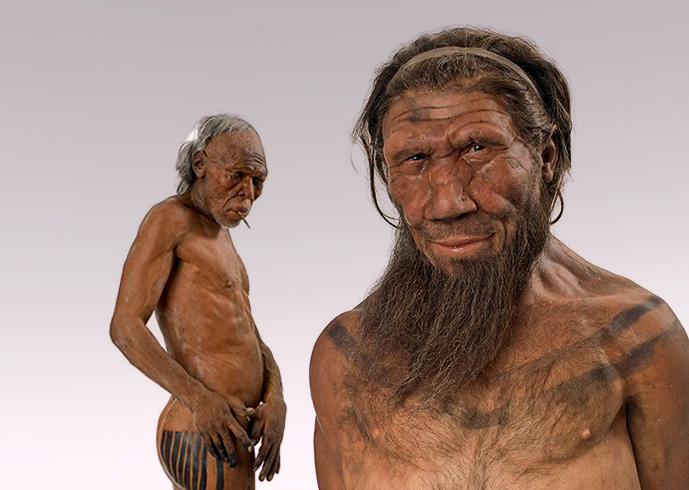
From photographs by Kevin Webb/NHM Image Resources/The Natural History Museum, London.
Presentation
The earliest forms ofHomo sapiens have been identified in North Africa, profoundly changing our understanding of the emergence of our species. Recent discoveries have also revealed traces of the first pioneer populations of Sapiensin Europe , on a continent still largely occupied by Neanderthals. What precisely happened when two similar but distinct humanities met on the same territories, tens of thousands of years ago ? Genetic, archaeological and paleontological data reveal that Neanderthals and Sapiens sometimes exchanged genes and, no doubt, techniques.
Research carried out over the last few years in western Eurasia has thus profoundly challenged the long-dominant model of a single wave of substitution and, for the first time , provided a better understanding of the mechanisms behind these processes. Far from a linear scenario, the expansion ofHomo sapiens appears as a succession of rapid advances, retreats, interbreeding and innovations. It was a long and winding process, often marked by setbacks, but decisive in the construction of today's humanity.