Lecture in English.
Abstract
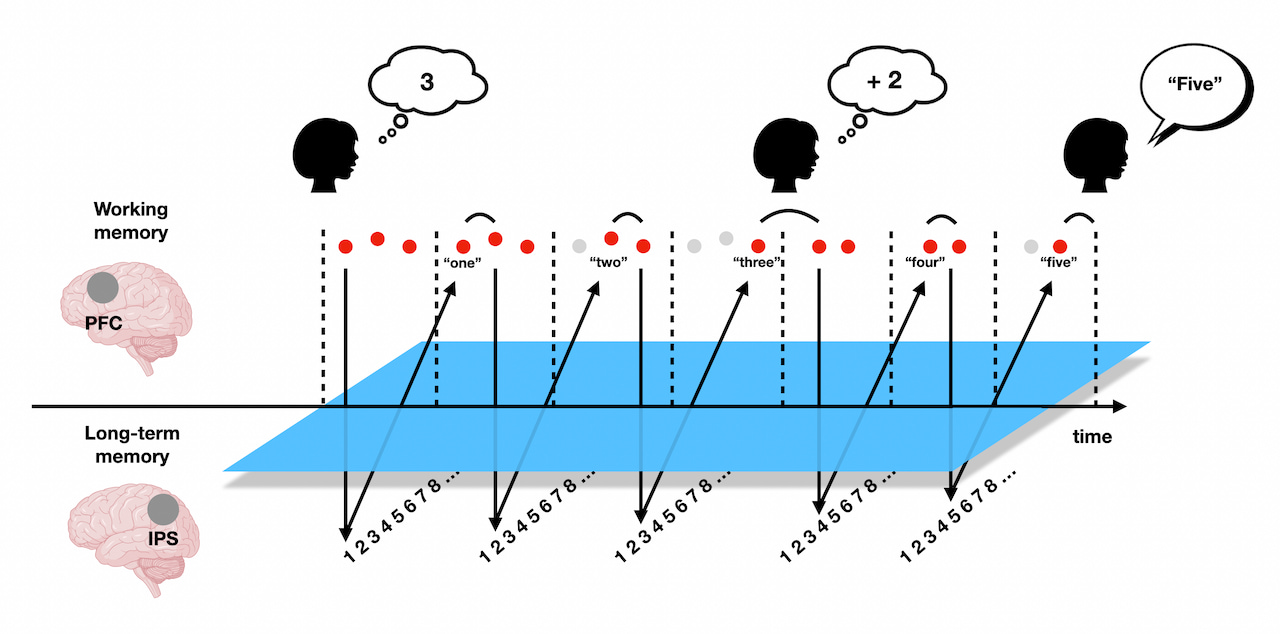
Counting is fundamental to the invention of arithmetic and to its development in children. Yet dominant models of mental arithmetic typically assume that counting is abandoned over the course of learning, replaced by the retrieval of associations between operands and answers from long-term memory. In this presentation, I will use mental addition as a test case and challenge that assumption. I will instead argue that counting remains at the heart of arithmetic fluency, even in adults. Drawing on behavioural and neuroimaging studies conducted in my lab with both adults and children, I will show that the counting procedures children initially use to solve simple addition problems are not abandoned but rather automatised, i.e., accelerated through practice until they become fast, effortless, and operate unconsciously and obligatorily alongside associative retrieval. I will present the ‘automatised counting’ theory of arithmetic that Catherine Thevenot and I have recently proposed, together with a model that we tested in a large cross-sectional neuroimaging study of arithmetic development. More broadly, this view suggests that automaticity may not necessarily rely on associative retrieval. It also raises the possibility that the automatisation of sequential procedures may underpin fluency in other symbolic skills, such as reading.
Jérôme Prado
Jérôme Prado is a CNRS Principal Investigator (Directeur de recherche) at the Centre de Recherche en Neurosciences de Lyon (CRNL), where he heads the Brain, Behaviour, and Learning Lab ( https://bbl-lab.fr ). He obtained his PhD from the University of Lyon and completed postdoctoral research at the University of Michigan and Northwestern University. Jérôme’s research programme seeks to understand the cognitive mechanisms underlying maths and reasoning skills in adults and children across the developmental spectrum. His work employs a range of methodologies, including behavioural tasks, parent-child observations, school-based interventions, and neuroimaging techniques (MRI and fMRI).
