Abstract
A fundamental operation in the syntax of natural languages is movement : certain elements are typically pronounced in positions distinct from the positions in which they are interpreted. Consider, for example, a question in French such as the following : Which book did Jean buy ? Here, the expression quel livre is to be interpreted as the thematic object of the verb acheter, but it is not in the canonical COD position; it has been moved to the sentence-initial position.
There are several types of movement, with partly different characteristics : wh-movement in interrogatives and relatives, nominal syntagm movement (in the passive, etc.), clitic movement, movement from a head to a higher head position, and so on. Are all types of movement acquired en bloc, or are different types of movement acquired at distinct moments in learning ? Corpus studies and experimentation clearly show that mastery of different types of movement is well spaced out over time : some constructions that involve movement are present from the start of the production of multi-word structures, before 2 years, while other cases of movement remain difficult until school age, and even after. Is there a principled basis for distinguishing between " easy " and " difficult " movements, learned late ? One factor that certainly plays an important role is intervention : a configuration where a displaced element " crosses " a similar element poses difficulties for the learner. This explains the contrast between subject relatives like (1), understandable at the age of 3 , and object relatives like (2), difficult to understand even after the age of 5 :

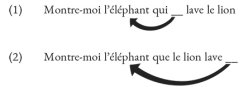
In (2) the nominal expression is moved from the object position of the verb wash to the head position of the relative, and this movement crosses the subject position le lion, another nominal expression with a similar internal structure, while the movement in the subject relative (1) does not cross any other nominal position, and therefore poses no special difficulties for the child.
Since grammatical theory has developed a structured analysis of intervention effects, special cases of locality effects (Rizzi, 1990), it's natural to capitalize on the theoretical literature to better understand the difficulties learners experience in relation to certain movement configurations (Friedmann, Belletti and Rizzi, 2009). This is a clear example of the fruitful interaction between grammatical theory and the study of language acquisition. Their respective contributions enable an articulated conception of the study of language, integrating theoretical modelling and experimental results in several fields.
