Abstract
How do mapping structures grow in language development ? In a recent article (Friedmann, Belletti and Rizzi, 2021), we studied the development of the complement system in Hebrew, analyzing a corpus of natural productions by children aged between 18 months and 6 years. One analysis tool proved invaluable : Guttman scales. This procedure makes it possible to highlight implicational relationships between properties, disregarding age.
We tested a simple hypothesis : the acquisition of complex structures proceeds in a bottom-up manner, or " bottom up " : the lowest part (A in the following abstract illustration) is mastered first, then an area B develops above A, then an area C is added, and so on :
Figure 1 - Acquiring complex structures

In this conception, there can be no internal holes, no missing internal zones. So a hypothetical stage like 3ʹ is excluded.
Figure 2 - The complementor structure
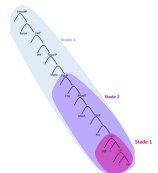
In the first stage, the subject-predicate structure of the sentence (IP) is attested, but there is no manifestation of the complementor zone. In the second stage, the lower part of the C system manifests itself, with questions involving elements such as who, where, etc., as well as cases of anteposition of adverbs targeting Mod. In the third stage, all the constructions involving the high part of the periphery appear : relatives, topicalization, questions introduced by why. The age at which children move from one stage to the next can vary considerably, but implication relations remain constant : no child produces relatives before questions, or questions with why before questions with whom, or topicalizations before questions.
Several issues remain to be studied. Among other things, we need to systematically verify that the results obtained for Hebrew can be reproduced for the acquisition of other languages. Nonetheless, the logic of bottom-up acquisition of the complex structure of the C system finds here its first systematic confirmation.
