Session 3: Animal
Intelligence Moderator: Nalini Anantharaman (Collège de France)
Abstract
This talk will first demonstrate how collaborative research between behavioral biologists and physicists makes it possible to quantify social interactions (attraction, repulsion, and alignment) among fish. These interactions are then incorporated into behavioral models capable of accurately reproducing the various collective states observed in nature: disordered schools, aligned schools, vortex formations, and more.
Next, experiments will be presented in which real fish interact with a robotic fish or with virtual fish controlled by these mathematical or artificial intelligence models. These robotic and virtual reality platforms allow us to measure how a fish or a school reacts to controlled disturbances introduced by these artificial partners, thereby refining our understanding of the mechanisms that govern collective behavior.
Finally, the lecture will illustrate how the principles governing the social interactions of schools of fish can be applied to the control of collective flight in swarms of autonomous drones.
Clément Sire
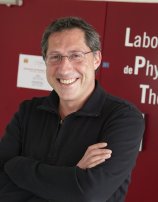
Clément Sire is a theoretical physicist. He began his career studying the electronic properties of condensed matter, focusing in particular on quasicrystals, quantum magnetism, and high-temperature superconductivity. He then turned his attention to the statistical physics of non-equilibrium systems: stochastic processes, phase separation, foam dynamics, systems returning to equilibrium, the physics of society, and behavioral biology.
Since 2013, he has devoted himself almost exclusively to the study of collective phenomena (movements, decision-making, organization, collaboration, etc.) in animal and human groups, in close collaboration with ethologist Guy Theraulaz in Toulouse. Together, they design experiments involving fish and humans to study the social interactions underlying their collective behaviors.
The originality of their approach lies in the development of methods that allow for the quantitative measurement of these social interactions within animal groups. These interactions are then incorporated into behavioral models inspired by statistical physics that are capable of reproducing and predicting the observed collective dynamics.
Speaker(s)

Clément Sire
CNRS Research Director, University of Toulouse
Events
Symposium
09:15 to 09:30
Symposium
09:30 to 10:10
Symposium
10:10 to 10:50
Symposium
11:10 to 11:50
Symposium
11:50 to 12:30
Symposium
14:00 to 14:40
Symposium
14:40 to 15:20
Symposium
15:20 to 16:00
Symposium
16:20 to 17:00
Symposium
09:30 to 10:10
Symposium
10:10 to 10:50
Symposium
11:10 to 11:50
Symposium
14:00 to 14:40
Symposium
14:40 to 15:20
Symposium
15:30 to 16:10
Symposium
16:10 to 17:00