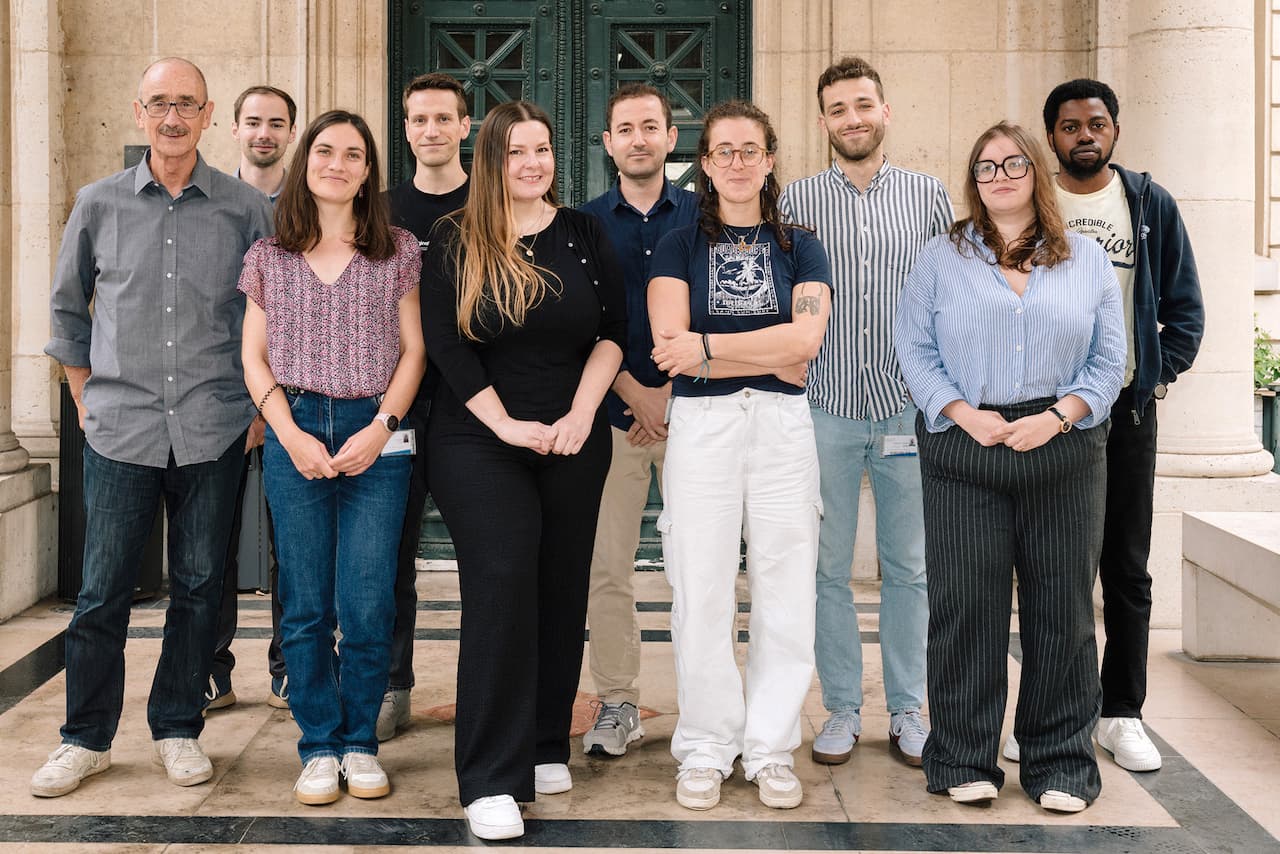
CIRB - Research team

Developmental Gene Regulation Lab

Developmental gene regulation laboratory

Principal Investigator: Denis Duboule

Presentation

Our laboratory started operating at the Center for Interdisciplinary Research in Biology (CIRB) at Collège de France in Paris in 2024. Its major aim is to study gene regulation during mammalian embryological development by using the recent tools of functional and structural genomics. A special focus is given to the study of how gene transcription is deployed during axial extension, in both space and time. We use different paradigms, among them Hox genes, their potential upstream regulators, and their target genes.

These genes have a special interest in the study of our ontogeny (our development as individuals) and our phylogeny (our origin as a group) and the detailed understanding of their regulation and functions will be an important step in the understanding of our own development and evolution. To achieve this, we have focused our research on the development of the main body axis, as well as of the appendicular skeleton (limbs) and the external genitals, in the mouse, chick, and zebrafish.

After many years of experiments involving both functional studies and chromosome engineering in mice, we ended up with a model accounting for the step-wise activation of these genes in time (temporal collinearity) during trunk extension. In 2017, to be able to challenge this model, we switched to another, more amenable experimental paradigm: the ES cells-derived gastruloid cultures in vitro. These biological objects are very much enriched in those cells (NMPs) where the Hox timer is implemented and somewhat represent a model for the posterior part of the developing embryo. It is thus an ideal system to visualize axial extension and to study its underlying molecular, genetic, and epigenetic mechanisms.
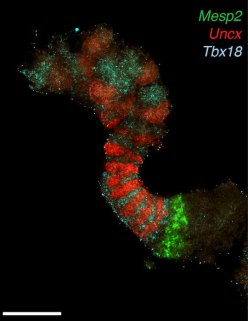
Coupe colorée de tissu biologique avec marquages Mesp2 (vert), Uncx (rouge) et Tbx18 (cyan)
Figure 1. Gastruloid embedded in matrigel (by Hocine Rekaik)

In the past few years, gastruloids have entirely replaced the use of animals in our laboratory and their reproducibility and ease of manipulation (they derive from the mere aggregation of ES cells) have also made them a tool for functional studies, in addition to regulatory approaches. With this in hand, we try to address several questions related to the relationships (if any) between gene regulation and chromatin structure. How does the 3D chromatin structure influence gene regulation in time and space? What is the importance of the partition of genetic loci into chromatin sub-domains in their regulation? Within such sub-domains, how does a particular target gene integrate the multiple influences from various surrounding enhancer sequences to establish its functional domain in time and space? How flexible is chromatin structure over developmental time and at particular genetic loci, and does this reflect regulatory mechanisms versus stochastic distributions?

The ERC DynaTrans synergy grant

In order to have a more precise idea about what is happening at a single locus, in a single nucleus, we need to develop and apply tools that allow for a direct visualization of transcription over time, precisely on those loci selected for chromatin-based studies. How frequently does an enhancer contact its target gene? Does this depend on its linear/spatial distance to the target? Do multiple enhancers or target genes form particular hubs?

ERC - European Research Council - Establish by European Commission

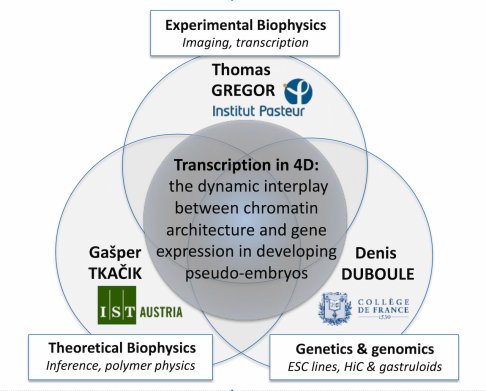
To try to answer some of these questions, we pooled forces with two laboratories with the requested expertise: that of Thomas Gregor at Pasteur Institute, which is well known for its physical approach to transcription at the single cell level and that of Gasper Tkacik, a laboratory expert in physical and mathematical modeling of biological processes. This small consortium is funded under the ERC program (Synergy Grant) and several laboratory projects are part of this research program.

Schéma illustrant la collaboration sur la transcription en 4D entre chromatin et expression génique dans les pseudo-embryons, avec les acteurs et leurs domaines d'expertise.
Figure 2: ERC Synergy Grant expertise intersection

Transcription in 4D: The dynamic interplay between chromatin architecture and gene expression in developing pseudo-embryos. DynaTrans.
Co-PI (1): Thomas Gregor, Institut Pasteur, Paris, France
Co-PI (2): Denis Duboule, Collège de France, Paris, France
Co-PI (3): Gasper Tkacik, IST Austria, Klosterneuburg, Austria


During mammalian embryogenesis, key events involving DNA and regulatory molecules over seconds and nanometers affect, and are affected by, major reorganization of the genetic material in the nucleus over hours and micrometers. How these scales are spanned and integrated into the course of development remains a major unresolved challenge. Progress in this quest is difficult, either because current model systems suffer from severe technical limitations or because existing analytical approaches probe individual spatial or temporal scales, thus ignoring their evolving interactions. Traditional live-imaging lacks the spatial resolution to accurately delineate chromosome organization at the scale of genes, while bulk molecular assays are ill-suited for studying development over time. Here, we propose a multi-disciplinary approach to the dynamics of developmental gene regulation to understand the details of the underlying mechanisms and their deployment over time. We combine and apply optical, molecular-genomic, and theoretical tools to recently available mammalian pseudo-embryos of the 'gastruloid' type, which allow for unprecedented precision in both developmental staging and sampling, large amounts of material, and easy optical access. By focusing on experimentally pre-selected gene loci, we track transcriptional activation and the interactions of distal DNA elements in real time along with the associated chromatin dynamics using interaction profiles. Our datasets are iteratively distilled into mathematical models of increasing scope, converging towards an integrative dynamic polymer model that simultaneously captures long-timescale chromatin rearrangements as well as short-timescale motions of genetic regulatory elements and transcriptional activity. We then challenge these models via genome editing and temporally defined interventions by building light-controlled tools to affect chromosome loops and/or nuclear condensates. This project has the ambition to reshape our view of how genes are regulated during mammalian development.

Compliance to and dissemination of the 3R principle

The engineering and use of 'pseudo-embryos' in vitro by starting from ES cells (and/or other cell types) is fully compliant with the 3R principle in animal research (Reduce, Refine, and Replace). While we want to make it clear that the use of gastruloids is not aimed at replacing the use of animals in research, we also like to show that some targeted questions among the most-timely in the field of mammalian developmental genetics may be addressed by using such surrogate systems, often in an even more efficient manner, thus leading to an important reduction in the number of animals used either as a source of material, or as mutant stocks. It is nevertheless obvious that the final demonstration of the potential findings derived from this research will likely call for the use of genuine animals, at least still for the next few years to come.

State-of-the-Art

Mammalian embryonic development requires the coordinated execution of gene expression programs, which involves the precise orchestration of molecular events occurring across vastly different spatial and temporal scales. Despite spectacular progress over the past decade, how the succession of these regulatory molecular events is translated into the considerably slower pace of the developing embryo remains an open question; particularly puzzling are the underlying mechanisms that are able to bridge spatial and temporal scales, from fast molecular interactions to slow developmental processes involving tissues. For example, we are lacking basic knowledge about how the information that ultimately determines the transcription of a gene makes its way from diffusing effector molecules (e.g., transcription factors) and their interaction with chromatin and DNA to the place where expression actually happens, and that only in specific cells and at specific times. This information must cross physical distances much larger than the relevant molecular scale, it must be selectively directed to reach the correct target at the right time, and it must navigate the spatial constraints of a crowded mammalian cell nucleus. How these processes unfold across spatial and temporal scales is fundamental to the fields of developmental and molecular biology and is the central theme of our research proposal.

Figure 3. 3D chromatin reorganization at Hoxd locus in gastruloid (Hocine Rekaik)

Hypothesis and objectives

Based on previous work from our and other laboratories, the generally accepted view is that the ordered arrangement of the highly packed and folded DNA polymer in the mammalian cell nucleus undergoes both fast and slow dynamical changes that are associated with the activity of key developmental genes. We hypothesize that these changes are triggered by the implementation of distinct transcriptional regulatory mechanisms, which are adapted to the various local DNA topologies and chromatin architectures found at developmental gene loci. Our overarching goal is to test this hypothesis and, specifically, to elucidate the causal chain of molecular events that connect transcription factor binding to regulatory DNA, dynamic rearrangements of chromatin, and the transcriptional activity of a gene locus. We propose an interdisciplinary approach, positioned at the interface of physics and biology, that is uniquely able to bridge the aforementioned spatial and temporal scales that are central to this problem.

DynaTrans innovative approach

To reach this ambitious goal, we will pursue our research in two phases. In the first phase, we will build a quantitative description of chromatin and transcription dynamics during development at a few experimentally selected gene loci, using optical, molecular genomic, and theoretical approaches to bridge the relevant temporal and spatial scales. In the partially overlapping second phase, we will challenge the emerging models from the first phase via functional perturbations to validate their key elements and identify the causal links between chromatin dynamics and gene activity. Our technical strategy is to integrate three major dynamic viewpoints: the global rearrangements of chromatin over developmental time through contact probability maps, the local dynamics of cis-regulatory DNA elements (CREs) involved in controlling locus architecture and gene activity, and the dynamics of the transcriptional output for selected gene loci in developing gastruloids. We are confident that this multidisciplinary approach will provide a quantitative structure-function relationship that links spatiotemporal architecture of mammalian gene loci with their functional output in a developmental context.

DynaTrans synergy team

To achieve such an interdisciplinary approach, we have assembled a team of three leaders in their respective fields that each have a track record for highly interdisciplinary and collaborative work. Biophysicist T. Gregor is an expert in developing novel quantitative imaging technologies in living developmental systems, bridging spatial and temporal scales between molecules and tissues in developing fly embryos. Developmental geneticist D. Duboule pioneered the use of engineering chromosomal rearrangements to study gene regulation during mammalian development. Theoretical physicist G. Tkacik has extensive experience in inference and modeling from large-scale datasets, bridging from the molecular scale to developmental patterning. The proposed work program rests entirely at the interface between the three PIs' expertise: a unique and novel theoretical approach will have to be developed (Tkacik) in order to connect the slow large-scale chromatin rearrangements during development (Duboule) to the fast molecular interactions in the sub-nuclear space (Gregor). Continuous exchanges will be essential to merge vastly different experimental datasets and to test the theoretical approaches. Gregor and Tkacik have published together extensively, most recently in polymer physics. Gregor and Duboule started collaborating lately and will lead neighboring laboratories in Paris.

Challenges and DynaTrans innovative unconventional strategy

An in-depth understanding of regulatory mechanisms governing gene activity during mammalian development requires us to overcome three critical challenges. First, traditional mammalian models hardly meet the demands of state-of-the-art experimentation, i.e., large and homogenous amounts of biological material for molecular genomics together with easy optical access for in vivo measurements. We will apply cutting-edge technologies to newly emerging stem cell-derived gastruloids, closely related to genuine mammalian embryos, to study in vivo the developmental dynamics of transcriptional regulation in mammals. The Duboule laboratory pioneered the establishment of gastruloids as a mouse model to investigate developmental gene regulation. Gregor pioneered the analysis of transcription dynamics and the first direct visualization of enhancer-promoter interactions in living embryos.

Second, we lack a productive interface between optical, molecular genomic, and computational modeling approaches. As a result, it is currently hard to reconcile different datasets and integrate the results into a consistent quantitative framework. We will develop the tools to integrate genomics and imaging data. We will formulate a mathematical polymer model that combines slow large-scale chromatin structure, fast small-scale DNA locus dynamics, and the dynamics of the transcriptional output of a gene locus. Such an interdisciplinary biology-physics connection between genomics, imaging, and quantitative modeling has not yet been achieved in any developing system. Tkacik and Gregor have long individual and collaborative track records in combining experiment and theory to bridge temporal and spatial scales.

Third, while correlations abound between dynamic rearrangements of the nuclear architecture and the transcriptional outcome, there is a dire need to establish causal links at all analytical levels in order to solve currently conflicting interpretations. We will address this crucial issue by proposing a model of the structure-function relationships with a testable predictive power. We will perturb transcription at the molecular level and simultaneously monitor structural changes (and vice-versa), performing experiments which have hardly been realized so far in any developing mammalian model.

Team photo, Developmental Gene Regulation Laboratory