In the mid-19th century, architect Paul Letarouilly designed an extension that was intended to become the institution’s new entrance. It reoriented the Collège de France from its current location on Place Marcelin-Berthelot toward Rue Saint-Jacques and continued to serve the public until 1944.
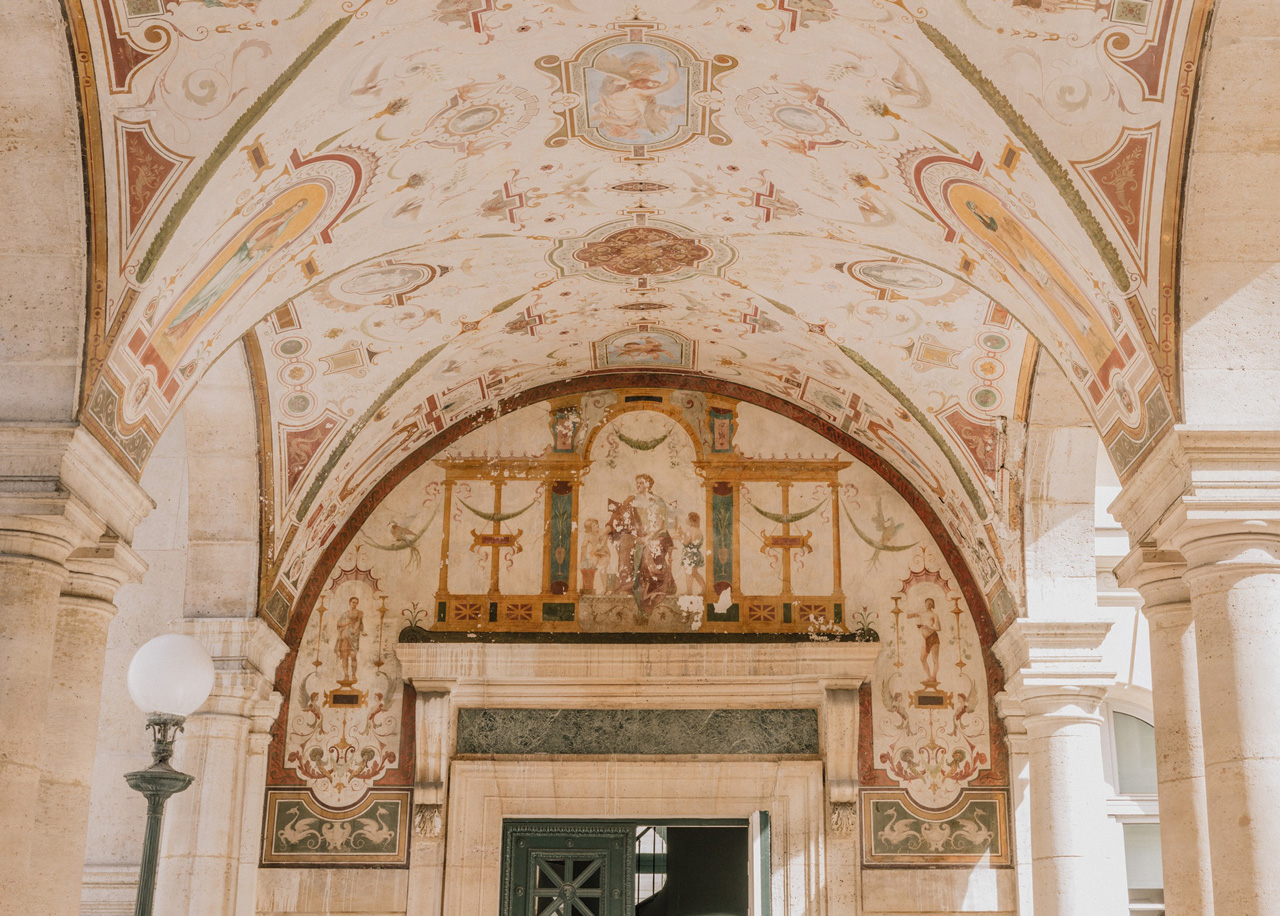
Two courtyards were created, separated by a portico leading to the new teaching spaces. Construction, which began in 1834, was completed in 1841. The portico with its three arches was not decorated until the late 19th century, in 1891, with a fresco by the painters Urbain Bourgeois and Louis Hista, depicting allegorical scenes inspired by the so-called “fantastic” Pompeian style. Geometric and symmetrical effects, small columns, plinths, and trompe-l’œil coffers, medallions, and garlands: these architectural elements against a white background reflect the ornamental style of the grotesque-style frescoes found in Rome’s Domus Aurea .
As the Collège de France prepares to celebrate its 500th anniversary in 2030, it is launching a major campaign to conserve and restore its heritage in order to continue attracting researchers from around the world and welcoming an ever-growing audience. The first phase of this restoration campaign involves the restoration of the Letarouilly portico.
This outdoor work, which is freely accessible, lies at the heart of the teaching spaces within the Collège de France buildings, which are listed as historic monuments.
These decorative elements form a collection of remarkable quality, unique in Paris, which is currently in a state of disrepair.
The project involves the complete restoration of the painted decorations, including the renovation and improvement of the structure’s lighting, inspection of the roof’s waterproofing, and the cleaning and consolidation of the exterior masonry.
The restoration of the painted decorations on the portico of the Cour Letarouilly is made possible thanks to the patronage of the Clément Fayat Foundation and the Jeunes Talents & Patrimoine fund of Crédit Agricole d’Île-de-France.
This project is supported by the Clément Fayat Foundation and Crédit Agricole d’Île-de-France.