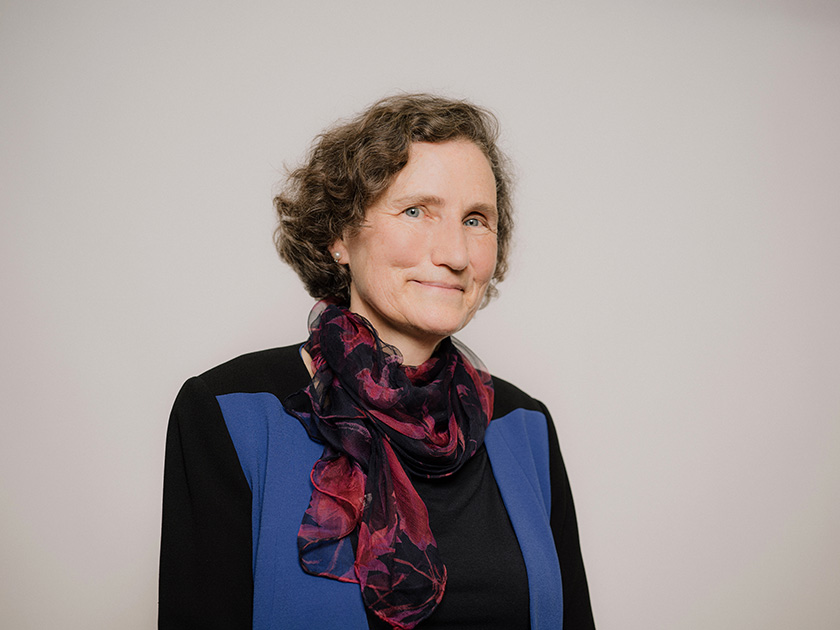
Research Director at the Inria center (Saclay), Wendy Mackay heads the Ex-Situ human-computer interaction (HCI) research group, shared with the Laboratoire de recherche en informatique (LRI - Université Paris-Saclay, CNRS). Internationally recognized in this discipline, she is a member of the ACM SIGCHI Academy (Association for Computing Machinery - Special Interest Group on Computer-Human Interaction).
For 2021-2022, she has been invited to join the Computer Sciences and Digital Technologies Chair, created in partnership with Inria.
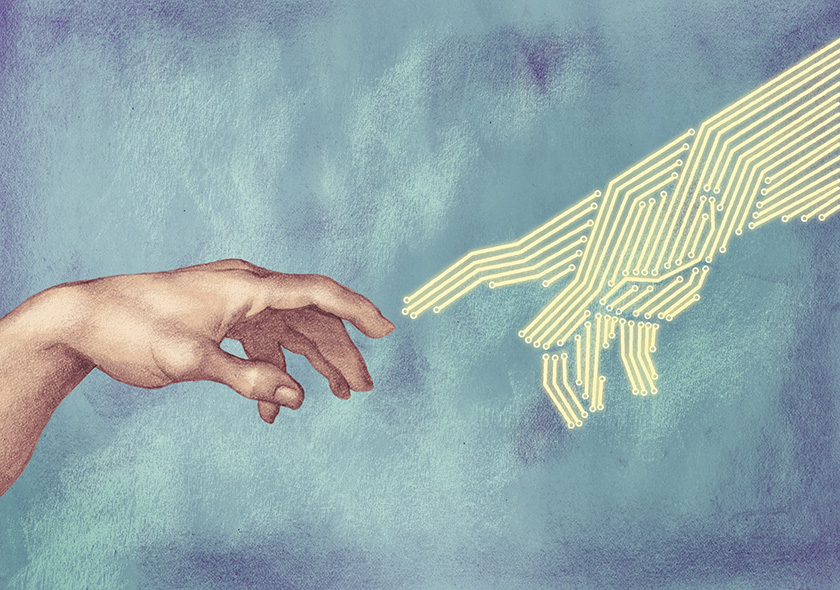
The study of human-machine interaction is crucial at a time when technology is ubiquitous. What should it be based on?
Wendy Mackay: It's interesting to study the machine on the one hand and the human on the other, but it's not enough. What we do in our field is try to understand how these two parts interact. As human beings, we are undeniably influenced by the technologies we use on a daily basis; these can affect our behavior and change the way we think, but we can also adapt them to our needs by making them our own. It's important to understand that all human capabilities are part of the human-machine interaction equation. This means taking into account notions such as sensation, perception, motor skills, memory... in short, the whole of human psychology. For example, one of our research topics consists in observing the phenomenon of deskilling, i.e. the process by which a human's skills are rendered obsolete, or even lost, when a piece of technology can perform the task for him or her. This decline in human capabilities has long been observed in connection with delegation to machines. However, we could go in the opposite direction and look for a way to enhance human skills and capabilities through this interaction.
How could we rethink this interaction to stimulate the user's abilities?
We're considering several strategies to achieve this. What's very pleasing today is that some researchers in the field of artificial intelligence are starting to work with us, specialists in human-machine interaction. Let's take the example of a decision that a user has to make with the help of software or a machine. If he has a system that tells him directly "choose A and not B", and the user knows that this system is generally right, he will simply do what the machine tells him, without resorting to his own reflection: his capacities are no longer stimulated, and they risk weakening.
If we design a system which, instead of directly giving the answer, has to react to a user's suggestion, then we create a situation which further stimulates human skills through reflection and interaction. It's a way of learning, no more and no less, between artificial intelligence and human intelligence. However, different interactions can have a wide variety of long-term effects on a user. So, it's quite complicated to set up.