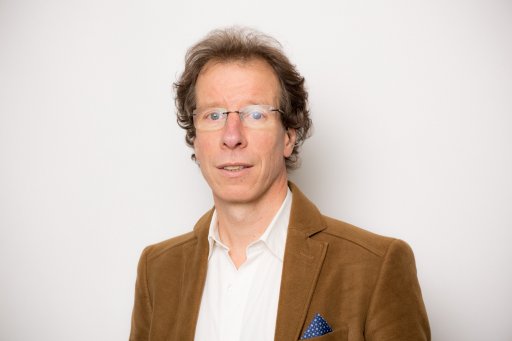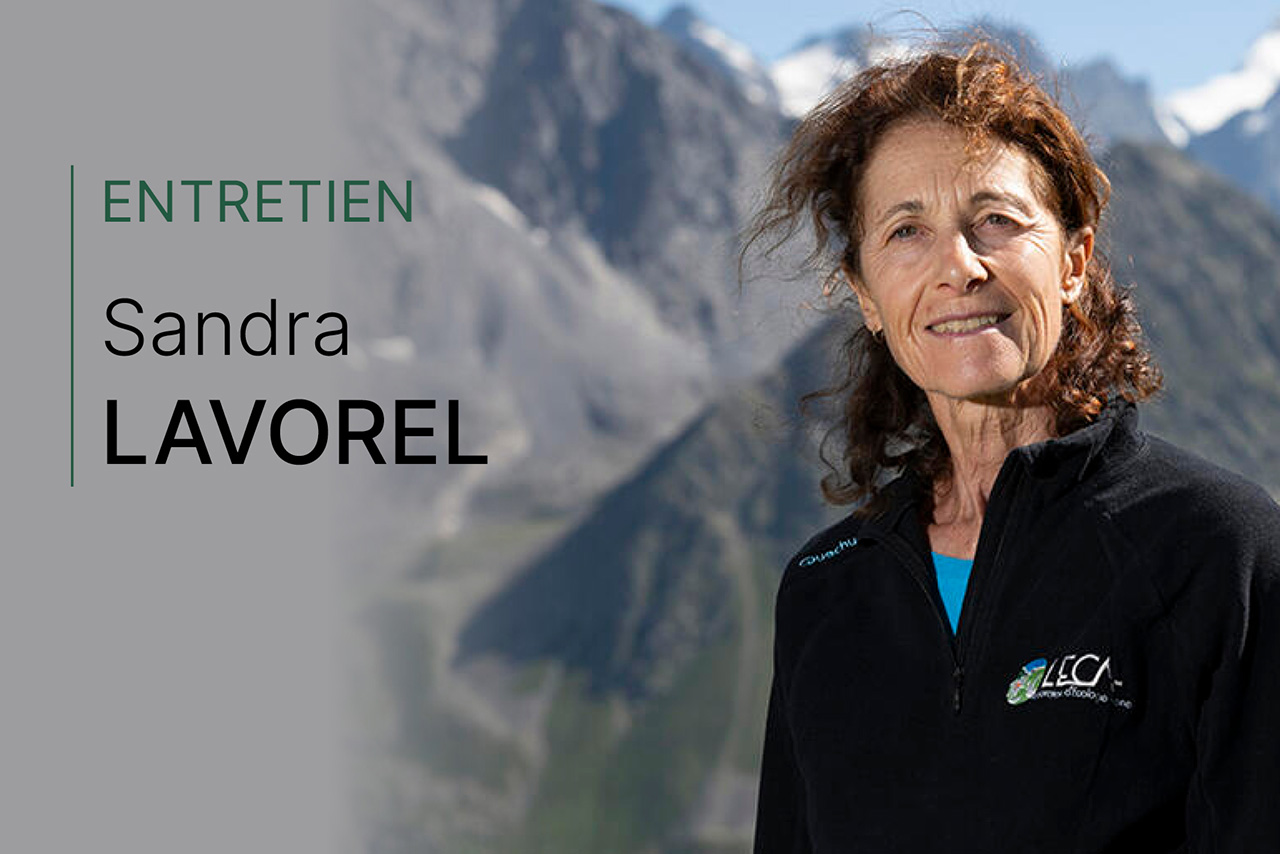
Sandra Lavorel has been a specialist in the alpine environment since her early years. A pioneer of functional ecology in France and around the world, her approach is to understand the functions of ecosystems and the mechanisms underlying the changes that affect them. At the heart of her work is the dialogue between nature and people.
She has been invited to occupy the Biodiversity and Ecosystems Chairfor 2025-2026 , which is supported by the Jean-François de Clermont-Tonnerre Foundation.
How did you become interested in science and ecology ?
Sandra Lavorel : On the whole, I'm lucky to have had teachers who got me interested in science as early as elementary school, and then again in secondary school. I enjoyed all subjects, but biology won out in the end, perhaps because I got out into nature a lot, especially for a child growing up in the city. I owe this in part to my grandparents, who lived in the mountains. Visiting them gave me the opportunity to discover this magnificent environment, which very quickly became my favorite. It has never really left me since, as I have made it the environment for my research into functional ecology.
At the start of your career, what was the scientific landscape of functional ecology like ?
The concept was still in its infancy. The idea, rather than focusing solely on describing ecosystems, was to look at how they functioned. During my PhD, the formal definition of functional ecology had not yet been published; it was still an emerging field. But once I'd finished my thesis, I went on to do a post-doctorate for three years at the Australian National University, where I joined a team working on the effects of global change on ecosystems. It was at this point that the functional ecological component was affirmed. I was lucky, because the director of the laboratory was one of the researchers who were beginning to think about modeling plant diversity on a continental and global scale. This was when the idea of " functional trait " - i.e. the characteristics that determine the functioning of an organism - really emerged, which was common with the work of ecophysiologists. I tested these approaches, which I very quickly wanted to develop, once back in France. In 1996, I was generously given the reins of a working group as part of the " Global Change in Terrestrial Ecosystems " program, which encouraged young researchers to get involved in international coordination.
After working on Mediterranean environments, you've now turned your attention to the mountains. What are your approaches to understanding and monitoring the evolution of alpine ecosystems ?
I first became interested in land use, then the climatic dimension came a little later. I first discovered - in practice, as this was becoming well known in the literature - that an ecosystem, at any given moment, is governed by a double determinism. On the one hand, by its history of use, and on the other, by its current use. So, if we want to understand the consequences of current and future uses, we can't get rid of a soil's history. It's a bit like a footprint, which is perpetuated in ecosystems. For example, if you take a hay meadow with a history of cultivation, it won't have the same ecology at all as a hay meadow that has always been mown, without ploughing the soil. Then I started to look at the climatic component. The principle behind climate change experiments is that we'd like to know what's going to happen in the future. Rather than observing the effects of a change, we want to understand its mechanisms. We started with " drought " experiments at , intercepting rain and watering our ecosystems with controlled quantities of water. Then, in the context of global warming, I joined a worldwide network of a dozen sites using a similar protocol in the Alpine environment to those already widely used in the Arctic. Small Plexiglas greenhouses are used to simulate warming conditions in a small area ( ), enabling us to obtain a 2°C rise in air and soil temperature. This places us precisely in the conditions of the famous +2°C scenario predicted by current models. The only drawback is that the phenomenon is almost instantaneous under these greenhouses, so we lack the transition period. We are working on two sites, at altitudes of 1 800 metres and 2 400 metres respectively, with naturally different temperatures and vegetation. What we're interested in is whether or not the change we're bringing about is having an effect, and why.
You are interested in the services that ecosystems provide to human societies. What are they, and how do you observe the impact of climate change on them ?
Ecosystem services are the benefits that humans derive from ecosystems and their biodiversity. They fall into three categories. Firstly, so-called material services, i.e. those that can be harvested : agriculture, wild foods, wood and water, for example. Then - and this is the most numerous category - there are all the regulatory functions, of which there are three subsets. There's climate regulation, through the capture ofCO2, or the emission of methane by certain soils and ecosystems ; biotic regulation, with pollinators and predators of crop pests. But we mustn't forget risk regulation ; a forest that stabilizes slopes and regulates avalanches and boulder falls, riparian vegetation that regulates floods, the water cycle and heat, particularly in cities. Finally, there are the non-material services that encompass all the functions of recreational activities, artistic inspiration, and spiritual and religious relationships with nature. We try to have measurable indicators for each of these services. For example, to measure pollination, we can count the number of pollinators on plants according to the situation we find ourselves in, in relation to land use and climate change. If the weather is warmer or cooler, are there more or fewer pollinators ? Are they the same ? Then, other indicators are partly subjective, since they come from the point of view of the humans who receive the benefits of ecosystems. Typically, for the beauty of a landscape or the recreational activities that take place there, we proceed by survey to determine the characteristics that the public deems favorable or unfavorable. As researchers, this gives us access to sometimes counter-intuitive information.
Your research combines the humanities and natural sciences. How has this intersection developed in your work ?
It takes many years. You have to meet the right people, establish a relationship of trust with them and develop shared interests. As ecologists, we can't go to sociologists and demand that they work on our ecosystems and the issues and notions we declare. We need to find a common interest, which means collaborating with different disciplines ; not only sociologists, but also geographers and anthropologists, depending on the situation and the issues. The key is to spend time together understanding each other, familiarizing ourselves with each other's issues, and developing a common vocabulary. This is the hallmark of any interdisciplinary approach, and there's also a learning component. For example, as an ecologist, I learned how interviews are conducted in the human sciences, and how they are analyzed. In our field, we make extensive use of participatory methods, i.e. involving local stakeholders in the research process. The basic approach is to ask them, using standardized methods, how they perceive an ecosystem or a change. However, environmental sciences are increasingly based on transdisciplinary approaches ; we now involve stakeholders in the construction of research questions. For example, agreeing on what subject we're going to experiment on. I'm currently working on an experiment in mountain meadows where we're combining a treatment to regulate water in the soil with a treatment to restore composition after disturbance by small rodents, such as voles. We have formalized this experimentation with a scientific mechanism ; the question stems from the major concerns of the players in the area where we are working.
Who are these stakeholders ? And what is at stake in your collaboration with them ?
We work at several levels. Locally, with farmers, residents and tourism professionals. On a broader scale, we also collaborate with institutions at the territorial level, such as the Grenoble metropolis, the départements, the chambers of agriculture, and even at government level. The challenge of dialogue with all these players is to raise awareness in both directions. We go out to meet the public and local players to present the nature of our research in accessible terms. This is an important part of our working philosophy. Then, in the other direction, this type of research requires us to listen to public players, their knowledge and perceptions.
This year, you have been awarded the Biodiversity and Ecosystems Annual Chair at the Collège de France. What does this mean to you, and what are your expectations ?
I'm truly honored to be admitted to the great institution that is the Collège de France. I'm delighted to be able to talk about functional ecology to the broad public targeted by the Collège, because it's still a relatively unknown sub-discipline. We may be familiar with certain elements within the public, but it's a very broad field, and I'd like to take this opportunity to take the listeners to my lectures and lectures to the frontier interfaces of this field. Indeed, it's a pity that some people think that functional ecology stops at the ecosystem. I want to show all the other dimensions, especially the human and social aspects. This is important from an educational point of view, as well as in terms of general communication. Ecology isn't just about observing an organism or measuring an activity. It's also, and even more so these days, about taking into account the return of ecosystems to humans.
Interview by William Rowe-Pirra, science journalist