Published on 10 February 2026
News

An exceptional heritage to protect

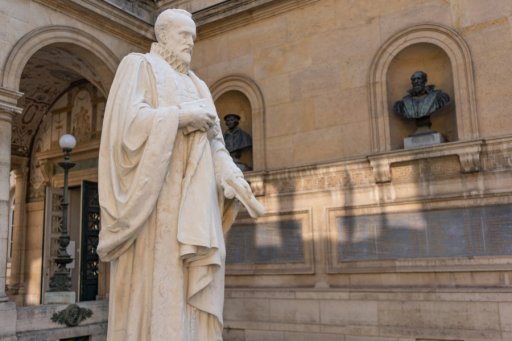
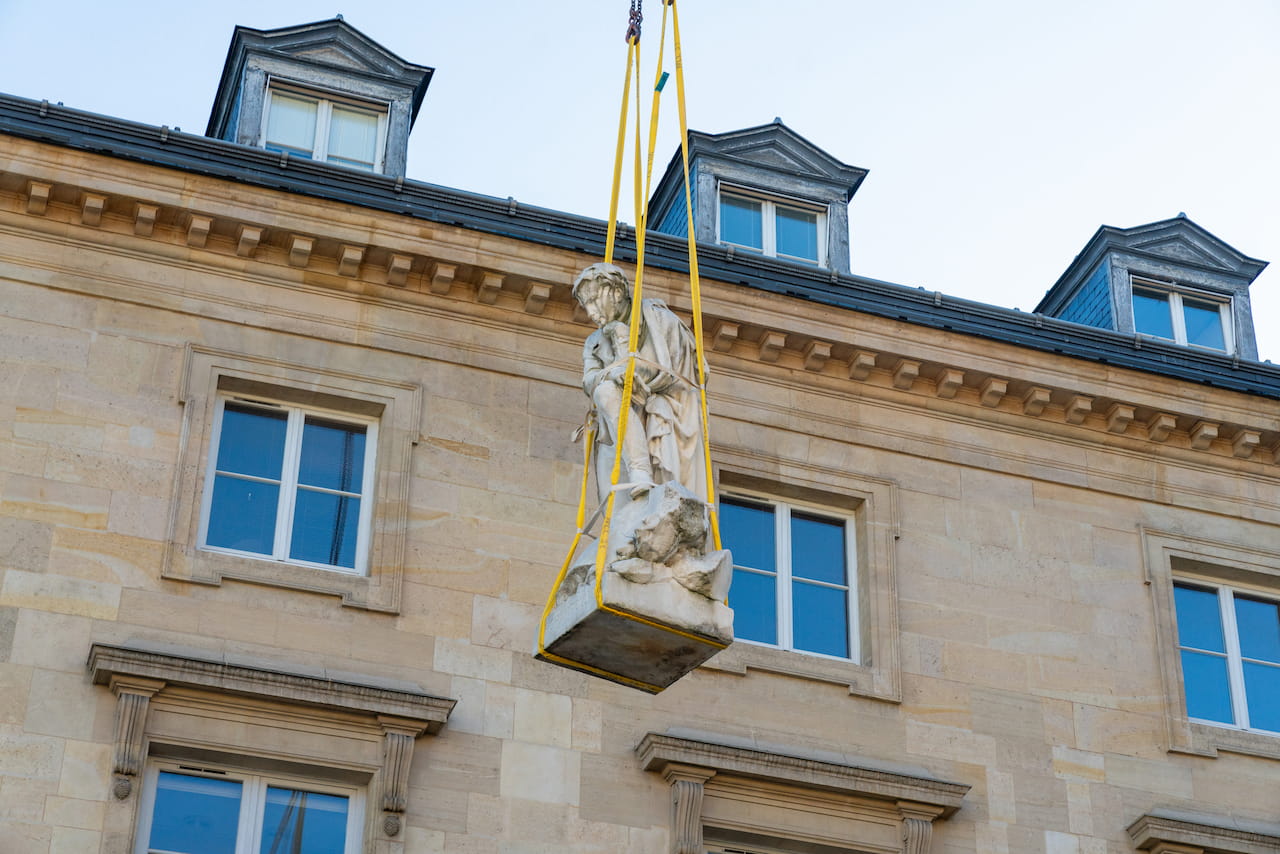
On February 4 2026, the Monument à Jean-François Champollion left the Collège de France.

patrick Imbert / Collège de France

The sculpture was conceived in 1865 by Auguste Bartholdi, who was both fascinated by Egypt and a fervent admirer of Jean-François Champollion. Standing 2.40 m high and weighing two tons, the work has been on display since 1878 at the Collège de France, where it has occupied a central position in the cour d'honneur since the 1910s. It is a reminder that the institution created France's first chair of Egyptology for Jean-François Champollion in 1831.

Exposed to the elements and severely altered despite two successive restorations, the statue had to be moved to a covered, protected area. It will now be on display at the Musée Camille-Claudel in Nogent-sur-Seine.

The emblematic work will not completely leave the main courtyard of the Collège de France. It will be replaced by a resin sculpture in June 2026.

This project is part of the conservation and restoration policy pursued by the Collège de France for several years, which aims to preserve, maintain and better present to the public the exceptional works and real-estate heritage enjoyed by the establishment.

Photos : © Patrick Imbert / Collège de France

The restoration and conservation of the statue of Jean-François Champollion was carried out with the support of the Louis Vicat Foundation.


What did Bartholdi mean ?

The position the sculptor gives to Jean-François Champollion may offend our contemporary sensibilities. This was clearly not Bartholdi's intention, as he drew his inspiration from two traditions : on the one hand, meditation before the ruins of vanished civilizations ; on the other, the Greek myth of Oedipus, conqueror of the sphinx. Combining the Greek sphinx with the Egyptian one, Bartholdi likened Champollion to Oedipus : " I wanted to make Champollion like Oedipus wresting the secret from the Sphinx ", he wrote in 1867.

But contrary to this tradition, Bartholdi does not depict the two protagonists face to face. With only one block available, he had to work on a vertical axis, which seems to place the scientist in a dominant position.

Bartholdi thus depicts Champollion as the man who, while solving the riddle of the Sphinx, shattered at his feet, is nonetheless meditative before the civilization revealed before his eyes. It captures the scholar in an attitude imbued with both triumph and humility : victorious over the enigma of hieroglyphs, he glimpses the greatness of a culture he has yet to understand.