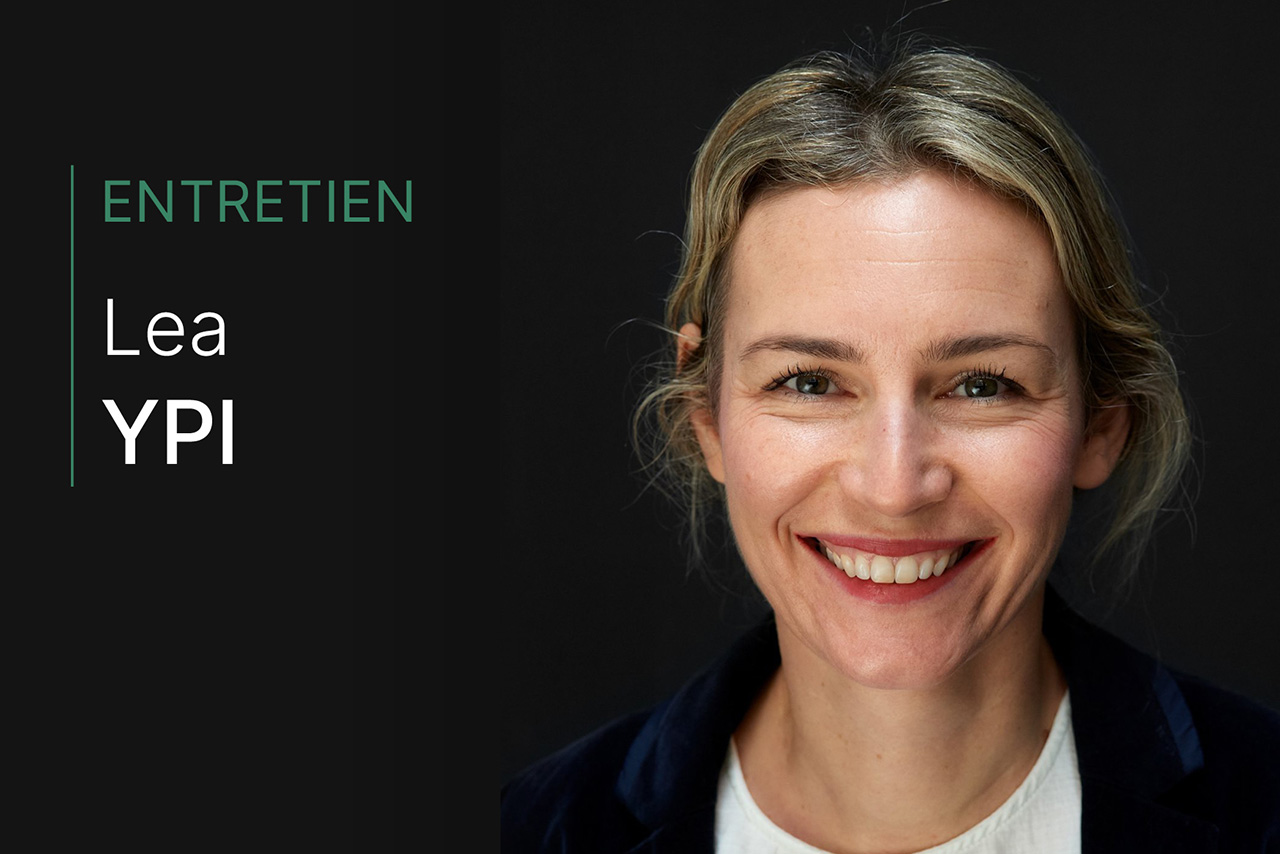
Albanian author and Professor of Politics and Philosophy at the London School of Economics, Lea Ypi explains how our capitalist society has contributed to shaping a distorted idea of freedom. In her work, she attempts to refound a political theory that would be more in line with the freedom thought of the Enlightenment.
For the year 2025-2026, she has been invited to take part in The Invention of Europe through languages and cultures Annual Chair, created in partnership with the French Ministry of Culture.
You speak of " disenchantment with the world ". What do you mean by this ?
Lea Ypi : I lived in Communist Albania until 1990. I saw capitalism arrive just after the collapse of the totalitarian regime of the People's Socialist Republic. For many of us, this was a time of freedom. We could now express ourselves at the ballot box and travel. This new way of life inspired immense hope, and many Albanians chose to emigrate to take advantage of it.
Paradoxically, this moment of effervescence and openness to the world was also accompanied by a form of disenchantment, as capitalism's promises of full freedom failed to materialize. Old forms of oppression may have come to an end, but new ones have emerged. Migration to Italy, for example, was followed by xenophobic and racist reactions. Another example is : in Communist Albania, culture was censored, yet accessible to all without financial compensation. In our capitalist societies, access to culture is subject to a cost, which itself becomes a factor of exclusion.
This disenchantment stems from 's realization that a society in which everything is commodified transforms relationships that were once based on mutual aid, such as childcare or neighborly solidarity, into economic transactions. This shift from a collective horizon to a market logic produces a profound sense of loss, as if opening up to the world were paradoxically accompanied by an impoverishment of our human ties and ideals.
Your work alternates between philosophical reflection and autobiographical narrative. To what end ?
Philosophy and literature are complementary ways of expressing the impact of ideas on individuals. With philosophy, it's possible to explain history with a capital H. There is also the " micro-history ", that which is conveyed through people's stories and experiences. In my view, the two complement each other in that literature is a way of seeing the effects of macro-history on personal life stories. Literature is a wonderful vehicle for telling these micro-stories, as it not only generates empathy, but also helps us understand the conflict between complex ideas and the lives of individuals.
You try to give new meaning to political socialism through the concept of " moral socialism ". What do you mean by this ?
I use the term " moral socialism " in opposition to other forms of socialism that were conceptualized during the XXthcentury. I'm thinking in particular of the state socialism that was applied in the communist regimes of Eastern Europe, or the democratic socialism that emerged in Western countries from the 1920s onwards. The first movement took the form of a non-democratic regime, where any form of political opposition was censored. The second lost influence in the years 1980-1990, with the advent of the doctrine of unregulated markets and the free movement of goods. By remaining mainly focused on reforming the nation-state, it failed to adapt to the pressures of globalization, which went far beyond the national framework and demanded egalitarian political responses on a transnational scale.
It was at this point that liberalism turned the corner and conquered most areas of our society : markets, schools and universities, to name but a few. In my opinion, it was at this turning point that we entered a vision where politics no longer served to regulate markets, but only to provide them with the necessary conditions to pursue the logic of profit more effectively and consistently. This is the moment when our politics has ceased to defend values, with the exception of those of the capitalist free market. My idea is precisely to say that we cannot remain with a political vision in which the moral question is absent. In short, I'm advocating a form of socialism with a return to values in politics.
You explain that freedom is the result of collective learning and can only be understood in relation to others. Do you think our liberal societies are prepared to sacrifice their own freedom for that of others ?
In our liberal conception, freedom is understood at the level of individual choice. It's not a freedom that questions the conditions of that choice. Freedom is not just about choosing a meal, a purchase or a destination. Being free also means thinking about what makes me free.
As a human being, I can choose to go on hunger strike to defend a cause close to my heart. According to Kant, this is true freedom, the kind we defend on a moral level. However, in a liberal society, we no longer ask ourselves the question of the justification of our choices; capitalism renders us incapable of asking ourselves these questions. We are inundated with false choices that give us an illusion of autonomy. These pseudo-choices are governed by advertising and algorithms. Above all, it's the market that imposes them on us.
You recently worked on the concept of human dignity in relation to migration. What have you learned from your research ?
In our liberal societies, we are told that migrants choose to migrate. In reality, it's political and economic conditions that force people to leave. Borders are open for the rich, but closed for the poor : just compare the citizenship gained through investment with the situation of those fleeing crises. It could be argued that those who decide to emigrate should stay at home, defend themselves and work to build a better future. In fact, the hardest thing about capitalism and work is that, quite often, workers who have been made redundant are told that they have a choice, that it's up to them. This freedom only applies to certain elites within a capitalist society.
Yet dignity is closely linked to freedom of choice on a moral level, insofar as without it, it is not possible to feel dignified. And our world doesn't allow us to think about dignity in the same way as we do about work, since conditions don't allow migrant workers to make the moral choices they'd like to make. Human dignity requires us to go beyond the legal categories that reduce people to their administrative status. However, migratory trajectories reveal the contradictions of states that proclaim equality while restricting mobility according to place of birth. It's not just individuals who suffer injustice in capitalism. States themselves are not all equal. They do not all borrow under the same conditions on the markets, nor do they all have the same wealth at their disposal... and their political choices suffer as a result. Thinking about dignity therefore implies considering the global structures - economic, political and historical - that shape migratory movements.
What do we need to restore meaning to freedom today ?
What I think is important for restoring meaning is to revisit the political narrative we're used to. It has to be said that it is above all the European right-wing parties that offer an alternative narrative to capitalism. The left limits its response to a compromise with capitalism, without thinking about a real alternative to the system. Even when more radical responses exist, they remain limited to the framework of the nation-state. It is perhaps more difficult for the left than the right to develop such a narrative, as the latter draws primarily on the past to construct its discourse.
On an individual level, there are also levers. As citizens, we need to ask ourselves what motivates our choices and actions, and the political mechanisms by which these ideas are reflected in the public sphere. The question of the political choices we make is fundamental. Political parties have become electoral machines that no longer question their democratic function. We need to ask ourselves whether our political representatives embody the moral choices to which we subscribe. There are certain citizen movements that inspire me, like those defending migrants, because their initiatives refuse to give in to an identitarian vision of politics, and they try to build an alternative narrative, where migration is seen more as a problem of global injustice, rather than as a question of belonging to a nation-state.
How do you think we can re-enchant Europe today, and through it, the idea of freedom that you hold so dear ?
We need to return to the heritage of the Enlightenment, i.e. to the critique of authoritarianism and power in all its forms, and to the ambition of a truly inclusive universalism. To avoid drifting off course, we need to rethink European institutions so that they truly protect the values they proclaim : freedom, equality and solidarity. Europe is based on ideas born of a history that has been both conflictive and emancipating. To re-enchant it, we need to reaffirm its values politically, and return to the socialist, federal and cosmopolitan spirit of the Ventotene Manifesto [a text that foreshadowed the idea of European federalism, written in June 1941, Editor's note]. In short, to imagine forms of cooperation that respond to global economic and political injustices.
Emmanuelle Picaud, science journalist