News

Potential Benefits and Harms of Geoengineering: What Does International Law Say?

Sustainable Common Future
Climate Visuals - © Colby Bignell

Professor Samantha Besson holds the Chair in “International Law of Institutions” at the Collège de France. As part of her 2023–2024 course on international science law , she gave a lecture on March 21, 2024, on the topic of scientific foresight in international law, including in the context of geoengineering.

What is geoengineering? In what capacity does international law address it?

Samantha Besson: In short, geoengineering is the intentional, large-scale manipulation of the global environment—such as the solar or marine environments—to counter anthropogenic climate change. I will focus here on marine geoengineering, which encompasses a range of technologies, activities, and processes aimed at removing carbon dioxide from the oceans by stimulating their primary productivity.

Marine geoengineering is one of the scientific techniques that could ultimately help combat global warming. However, it also poses a serious and irreversible threat to the marine environment and, consequently, to humanity as a whole. As such, it must therefore be subject to scientific foresight measures under international law.

What exactly is “scientific anticipation” in international law?

“Scientific anticipation” refers to any measure aimed both at preventing or mitigating the potential harms of science and at promoting its potential benefits.

Scientific anticipation includes measures taken in accordance with the principles of precaution and prevention with regard to potential harm, but also, more generally, any measure of foresight or prudence aimed at anticipating both the potential benefits and harms of scientific research. Most often, this will involve regulating and overseeing such research, but scientific anticipation may sometimes lead to the adoption of a moratorium or even a permanent ban on certain scientific research.

You may have noticed that I mention the prevention or promotion of potential effects of science. However, scientific anticipation measures do not focus solely on the applications of scientific research, but rather on the research itself. It is this research that can therefore be considered, in and of itself, as “dangerous” or, conversely, as “beneficial.” It would indeed be futile to distinguish between science—which is never dangerous—and its potential applications, which alone might be so. So-called “pure” or “basic” scientific research cannot and must not be pitted against its “applications.” The two processes are always intertwined. On the one hand, the experience of applying knowledge is crucial to the acquisition and consolidation of that same knowledge as “know-how.” On the other hand, sound knowledge develops precisely by moving toward its application—and thus by anticipating it—rather than independently. It is also for this reason that it is not plausible to fundamentally separate the sciences from the techniques or “technologies” through which these sciences are continually tested and developed (even if the reverse may be true: not all technologies give rise to science).


Among the documented geoengineering techniques, one would involve injecting aerosols into the stratosphere that would reflect solar radiation. However, this could profoundly alter the appearance of the sky, as was the case during the massive eruption of Mount Tambora in 1815. That event influenced Joseph Mallord William Turner’s color palette when he painted the work shown above: The Fighting Temeraire.

What makes the issue of scientific foresight particularly pressing in law today?

The first reason stems from the development over the past twenty years or so of scientific research into very specific technologies—such as marine geoengineering, genomics, and artificial intelligence—that can be described as “dangerous.”

These new technologies have four characteristics. The first and second are that, if they were to be applied, they would have an impact on human beings and their environment that is not only “seriously harmful” but also lasting, even “irreversible.” The third characteristic of this scientific research is that it is dual-use and therefore also—and inextricably—potentially “beneficial” to human beings, which complicates the precautionary measures that must aim both to prevent its harmful effects and to promote its benefits. The fourth characteristic of this dangerous scientific research is that it is “uncertain.” Indeed, both the beneficial and “harmful” effects of this research are only potential. This is why we can speak of “danger” to refer to the potential for harm or the “threat” of harm, but not yet of “risk” in this context. The concept of risk implies a certain probability, which—in the face of uncertainty—cannot yet be established. The Chernobyl nuclear disaster was potential but uncertain, and the risk was therefore nonexistent or very low, even though the potential harm was very serious and irreversible, as subsequently proved to be the case. It should therefore have been prevented more proactively, without waiting for the risk to materialize.

A second reason to focus today on anticipating such dangerous scientific research, such as marine geoengineering, is the limitations of the legal framework in this area.

This work of scientific anticipation—though urgent—is complicated by the uncertainty that characterizes these new technologies and the related scientific research. This uncertainty poses at least three challenges for the dominant models of scientific anticipation in law. First, these models are based on risk analysis, and thus on a calculation of probabilities. It is on the basis of this calculation that one would then seek to maximize benefits and minimize harms. Because the dangers posed by the hazardous scientific research in question here are still uncertain, these models do not allow for their effective anticipation. And this is despite the fact that these dangers are potentially very serious. It is, in fact, for this very reason that the dominant models have come to discredit the precautionary principle (which applies in the absence of scientific certainty regarding future serious and irreversible harm), rather than celebrating it as a form of diligent prudence.

In fact—and this is the second problem with the models of scientific anticipation currently in use in contemporary law—they recommend, in the face of scientific research with the potential for serious and irreversible harm (albeit uncertain), that we wait until scientific knowledge is more firmly established to gain greater certainty one way or the other. Yet we know how difficult it is to scale back research once its economic engine is up and running and public and private investments have been made. This risk-based approach to scientific anticipation therefore favors the scientific (and economic) status quo—or even a headlong rush forward. Finally, the third difficulty with the dominant models of scientific anticipation stems from the fact that they are based on scientific certainty, as is the case with the anticipation of risks associated with other dangerous non-scientific activities. They thus make science a central element of scientific anticipation, thereby making it both judge and jury in the assessment of its own benefits and harms. And yet, when science itself is uncertain—as is the case here—scientific expertise regarding its potential benefits and harms is of no help whatsoever.

Swimming pool at the Prypiat Municipal Gymnasium, near Chernobyl. - © Séb Mar

Given the challenges of anticipating the consequences of this dangerous scientific research, what resources are available under international law?

The issue of anticipating the benefits and harms of scientific research is not new in international law. In fact, it has been a central concern of international science law since its postwar origins.

Initially, the debate was dominated by scientific research on dual-use technologies—including those with dangerous military applications, such as nuclear research or research on chemical weapons. After the war, various treaties were adopted to limit and regulate research on weapons or in certain areas, such as Antarctica or outer space. At the same time, the issue of biological research—particularly racial biology and later eugenics—led to various UNESCO declarations in the 1950s. The organization subsequently continued its work in the field of biomedical research by adopting various declarations and recommendations beginning in the 1990s.

More generally, it is also important to mention the 1975 United Nations General Assembly Declaration on the Use of Scientific and Technological Progress in the Interest of Peace and for the Benefit of Humanity. The Declaration emphasizes the importance of both ensuring that humanity reaps the benefits of science and protecting it from its harmful effects. This dual mission of scientific foresight was reiterated by UNESCO in its 2017 Recommendation Concerning Science and Scientific Researchers.

Nevertheless, at present, international science law does not contain a general and universal binding instrument relating to scientific foresight. The issue is addressed on a case-by-case basis, specific to each type of science and within various branches of international law, such as international environmental law, international law of the sea, or international biomedical law.

A legal framework upon which to establish genuine, general, and universal obligations regarding scientific anticipation would be the human right to science. This approach offers multiple benefits. First, by making scientific anticipation a matter of human rights, it would ensure the protection of the interests of the individual rather than those of society at large. Second, the issue of anticipation would become an internal matter for science itself. The aim would be to protect science while also limiting it. This would make it possible to move beyond the false dichotomy between, on the one hand, the freedom of scientific research for researchers—who would enjoy a freedom without internal limits—and, on the other hand, the human rights of the general public, which would need to be protected by imposing external limits on science. On the contrary, all these interests must be protected under the same human right (to science), and all pertain to the protection of science—including protection against science itself.

To date, unfortunately, the obligations regarding scientific foresight grounded in the human right to science have not yet been sufficiently interpreted and implemented. Foresight in the field of marine geoengineering research is a telling example of this.

More specifically, what is the current regime of international law applicable to scientific foresight in the field of marine geoengineering?

Marine geoengineering is governed by customary law and general principles relating to environmental protection, as well as the rules and principles contained in Part XII of the 1982 Convention on the Law of the Sea. It is also addressed by the 1992 Convention on Biological Diversity (CBD) and the 2000 Cartagena Protocol on Biosafety. In addition, the oceans are subject to a number of specific regional and sectoral regimes that may apply to marine geoengineering, such as the 1959 Antarctic Treaty and its 1991 Environmental Protocol and, most notably, the 1996 London Protocol to the 1972 London Convention on the Dumping of Wastes at Sea.

This applicable international law has given rise to various moratoriums on marine geoengineering, though these are not always binding. For example, in 2010, the States Parties to the CBD transformed a non-binding moratorium on ocean fertilization into a broader moratorium on all climate-related geoengineering activities that could affect biodiversity. The States Parties to the Convention on the Law of the Sea followed suit by adopting their own non-binding resolution, agreeing that “ocean fertilization activities, other than legitimate scientific research, should be considered contrary to the objectives of the Convention and the Protocol” and therefore temporarily prohibited.

Finally, concerned that ocean fertilization could cause serious harm to the marine environment, the States Parties to the London Protocol adopted a framework for assessing ocean fertilization activities in 2007. This framework requires that two conditions be met for such activities to be authorized: first, evidence of “appropriate scientific characteristics,” and second, a “comprehensive environmental impact assessment” to ensure that the proposed activity constitutes “legitimate scientific research” that is not contrary to the objectives of the London Convention and its Protocol. Initially not legally binding, this assessment framework became mandatory in 2013 in the form of a resolution. This followed a highly controversial and unauthorized ocean fertilization project carried out by a Canadian company off the west coast of Canada. The London Protocol was then amended to impose a binding ban on all marine geoengineering processes listed in a new annex. A special operating permit may still be issued, however, but only if the two conditions—scientific legitimacy and impact assessment—mentioned above are met.

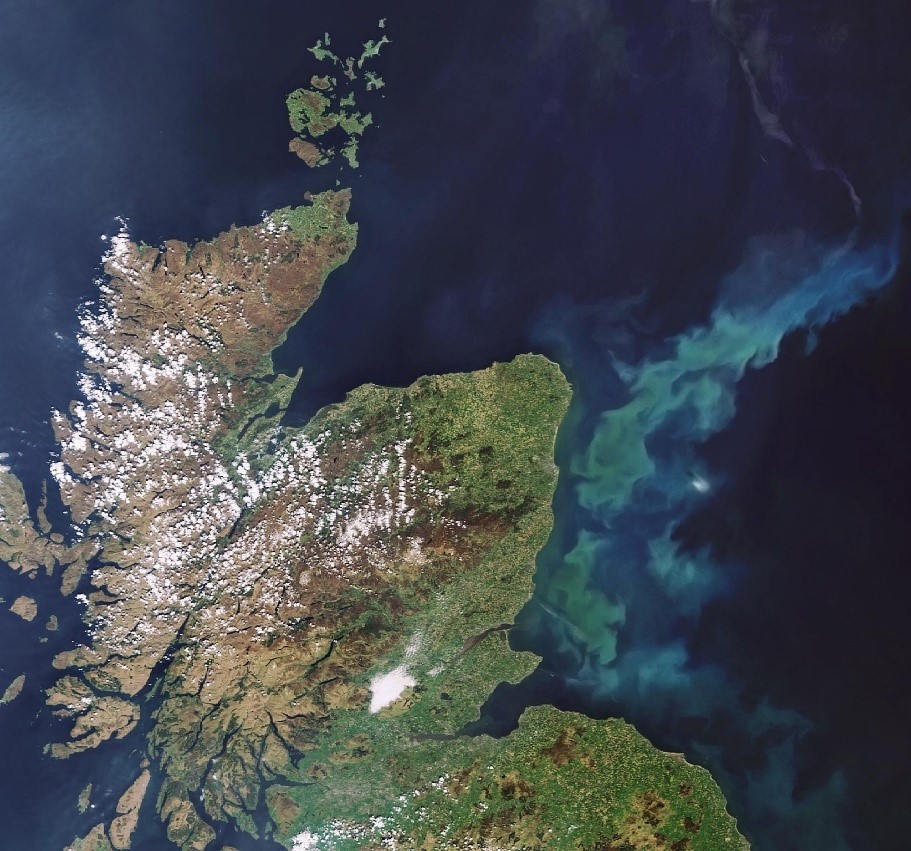
This satellite image taken by Envisat shows, in dark green, the large expanses of phytoplankton off the coast of Scotland. Marine geoengineering aims, in particular, to promote the proliferation of these organisms, which are capable of converting carbon dioxide into oxygen (photosynthesis).

What are the challenges posed by the current international legal framework governing scientific foresight in the field of marine geoengineering? And how can these challenges be addressed?

Based on the obligations of scientific foresight that can be derived from the human right to science, there are three possible criticisms of the current international legal framework for anticipating the potential serious and irreversible harms of marine geoengineering.

First criticism: the procedure and the technoscience underlying scientific anticipation. As noted previously, the assessment of potential harms from marine geoengineering provided for in the 2013 resolution’s assessment framework relies entirely on an evaluation by scientific experts. Furthermore, the standard for this assessment is the scientific legitimacy of the research in question—a legitimacy that must be evaluated based on an environmental impact assessment itself established according to scientific standards in environmental research. In light of the obligations to anticipate risks based on the human right to science, it would be appropriate to reform this scientific anticipation procedure by expanding the composition of the assessment bodies to include representatives of the general public, on the one hand, and by making the process more participatory and deliberative, on the other. We should also avoid the circularity inherent in an entirely scientific standard for assessing the potential harms of marine geoengineering: this effectively amounts to evaluating the potential harm caused by scientific research based exclusively on its scientific quality.

Second criticism: the purpose—and the anti-humanism—of the scientific foresight in question. The purpose of the assessment of geoengineering research established by the London Protocol focuses primarily on the protection of the marine environment. In light of the obligations of foresight grounded in the human right to science, it would be appropriate to revisit this scientific foresight procedure by expanding its scope to include the protection of the human person in general—without, of course, excluding the protection of that person’s marine environment. In particular, the assessment should be guided by a greater sense of scientific humanism: only scientific research that benefits human beings can, in fact, be protected by the human right to science.

Third Criticism: The Criteria and the Utilitarianism of the Scientific Anticipation in Question. The evaluation criteria established by the London Protocol take the form, as is generally the case in international environmental law, of a risk assessment and a cost-benefit analysis through an impact assessment. In light of the obligations of foresight grounded in the human right to science, it would be appropriate to revise this procedure by developing an interpretation of the precautionary principle that does not implicitly rely on risk analysis, but rather on due diligence. This also applies to the proportionality review, which should be conducted as a qualitative test of necessity in a democratic—and therefore egalitarian—society, rather than as a simple cost-benefit analysis.

Learn more

Prof. Besson’s course on International Science Law (2023–2024) can be viewed here . An introduction prepared for the Collège de France Foundation is available here . The lecture “Scientific Anticipation or the Science of Anticipation?”, which deals specifically with marine geoengineering, can be viewed here . Finally, here is a link to a special issue on scientific anticipation in the context of the human right to science.