Laurence Boisson de Chazournes (ed.)
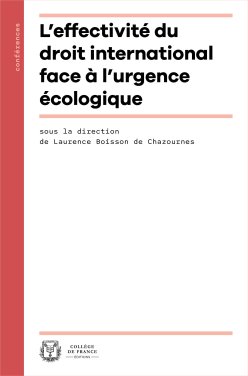
The Effectiveness of International Law in the Face of the Ecological Emergency
In the face of the ecological emergency, what measures can be taken to make the law more effective, both for public and private actors?
International environmental law, often portrayed as a relatively young field, has in fact reached a certain level of maturity. Born out of the United Nations Conference on the Human Environment held in Stockholm in June 1972, it has since developed considerably through the adoption of numerous agreements and instruments of regional and global scope. Attention is now turning to the need for a more prescriptive body of law to complement one based on exhortation and incentives. While progress has been made in implementing commitments, environmental protection faces the challenge of achieving concrete results—also known as “effectiveness”—amid an ecological emergency. New approaches are emerging to address this challenge, involving both public and private actors. This book analyzes these developments, including the evolution of the content of norms and standards, the judicialization of the enforcement of international environmental law, and the recognition of rights for nature.
Boisson de Chazournes, L. (ed.), The Effectiveness of International Law in the Face of the Ecological Emergency, Paris, Collège de France, “Conférences” series, 2024, 296 pp.
ISBN: 978-2-7226-0648-7
Price: €32
Publication date: September 26, 2024