A specialist in soft matter and fluid mechanics, Lydéric Bocquet studies nanofluidics and its unique properties with a view to finding practical applications that support the energy transition.
He has been invited to hold the Technological Innovation Liliane Bettencourt Annual Chair for the 2022–2023 academic year.
Nanofluidics is the study of how fluids behave in channels at the nanoscale. How did you come to be interested in this transdisciplinary field?
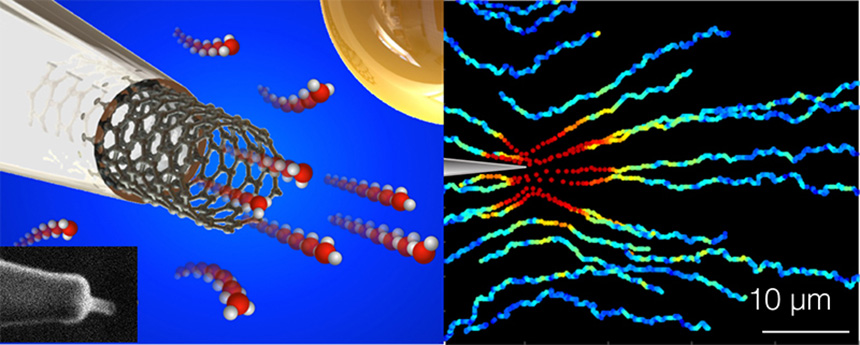
Lydéric Bocquet: Originally, I was trained as a theorist. I studied statistical physics—that is, physical systems composed of a large number of particles. Quite early in my career, I became interested in confined fluids and their unique properties, primarily from a theoretical perspective. But I realized that this issue of fluids at the very small scales was notably lacking in well-controlled experimental studies. We can theoretically predict many phenomena, but that’s somewhat pointless if we don’t have the means to grasp the reality of nature (since it’s often far more unexpected than we could ever hope for). The major hurdle was that we didn’t know how to build nanosystems suitable for studying fluid transport at the nanoscale, let alone how to quantify the molecular flows within them. In 2002, when I became a professor at the University of Lyon 1, I decided to shift the focus of my research by developing my own experimental work. I formed a group with a few colleagues focused on what is known as “soft matter,” and then turned my attention to the field of fluid transport in very small systems. My team and I set out to explore fluid flows in nanosystems, such as nanotubes, or more recently, graphene [1]; all of these systems have opened up new possibilities for addressing these questions. Previously, the few results in this field focused on membranes, and many were quite surprising—even controversial—for example, regarding the properties of nanotube membranes for water transport. Between 2008 and 2010, together with a few colleagues and some courageous students, we set out to examine this problem by studying flow in single nanotubes. That was the beginning of this adventure, and since then, I have carved out my niche in what is known as “nanofluidics”—the general study of fluid properties at the nanoscale. I have sought to understand the emergent properties, which differ from what we typically observe on larger scales, making this a distinct disciplinary field at the interface between the continua of hydrodynamics and the molecular—or even quantum—nature of condensed matter. We’re working at the frontiers of the unknown, and some of our discoveries are truly unexpected.
You recently worked on what’s called an “ionic neuron.” What is that?
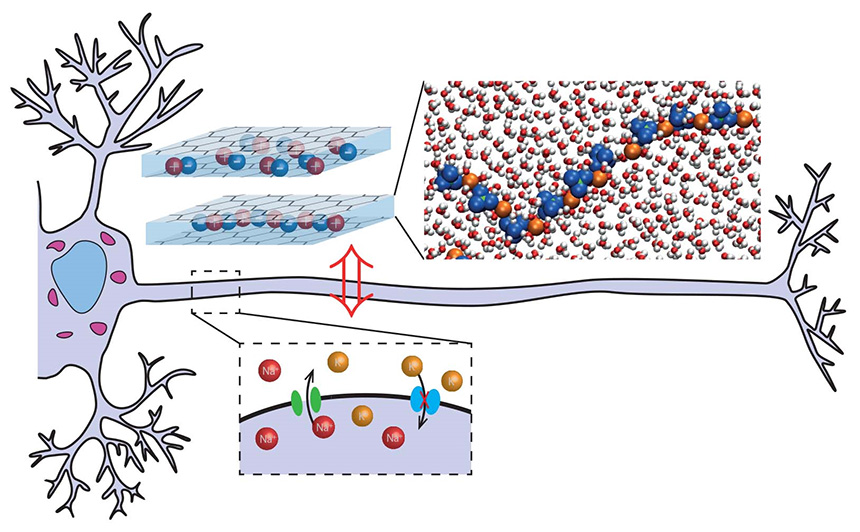
This is a classic example of an unexpected application of nanofluidics. This research began with a theoretical study of the properties of ionic systems in two-dimensional structures. In fact, we’ve only recently been able to fabricate such channels using what are known as “van der Waals assemblies,” developed by the team of Nobel laureate Andre Geim, with whom we collaborate extensively. These assemblies are very interesting because they allow us to fabricate extremely fine channels. Thus, for the first time, we were able to create and perfectly control the flow of fluids or ions through channels that measure only a few angstroms [2] —essentially two-dimensional. In general, the properties of two-dimensional systems are very unusual; ions interact very strongly, for example. We had predicted that clusters of ions would agglomerate to form a structure resembling a sort of spaghetti. Through theory and numerical simulations, we saw that it was possible to break up these spaghetti-like structures, but that they could then reassemble. This is a very complex dynamic. However, since these ultra-confined ion filaments are quite large, this process takes time to unfold; and a memory-like phenomenon emerges. This is a property that resembles—or even mimics—that of neurons in our brain. We first demonstrated this theoretically in 2021 by reproducing a few very basic neural functions. Then, in 2022, we moved from theory to experiment and demonstrated these mimicked neural functions in our two-dimensional channels. In particular, using these nanofluidic channels, we were able to replicate, in a very similar way, the functions of synapses, which form the basis of learning in our brains. This is a perfect example of a completely unexpected result: when we confine water at the nanoscale, we observe behaviors that bear no resemblance to what we know at larger scales.