17:30 to 19:00
Special events

Working with Foucault: The College's Seminars

Pasquale Pasquino & Carolina Verlengia
17:30 to 19:00
Maurice-Halbwachs Amphitheater, Marcelin-Berthelot Site
Open to all, subject to availability
-
Patrick Imbert - © Collège de France.

Moderator: Aurèle Méthivier

Abstract

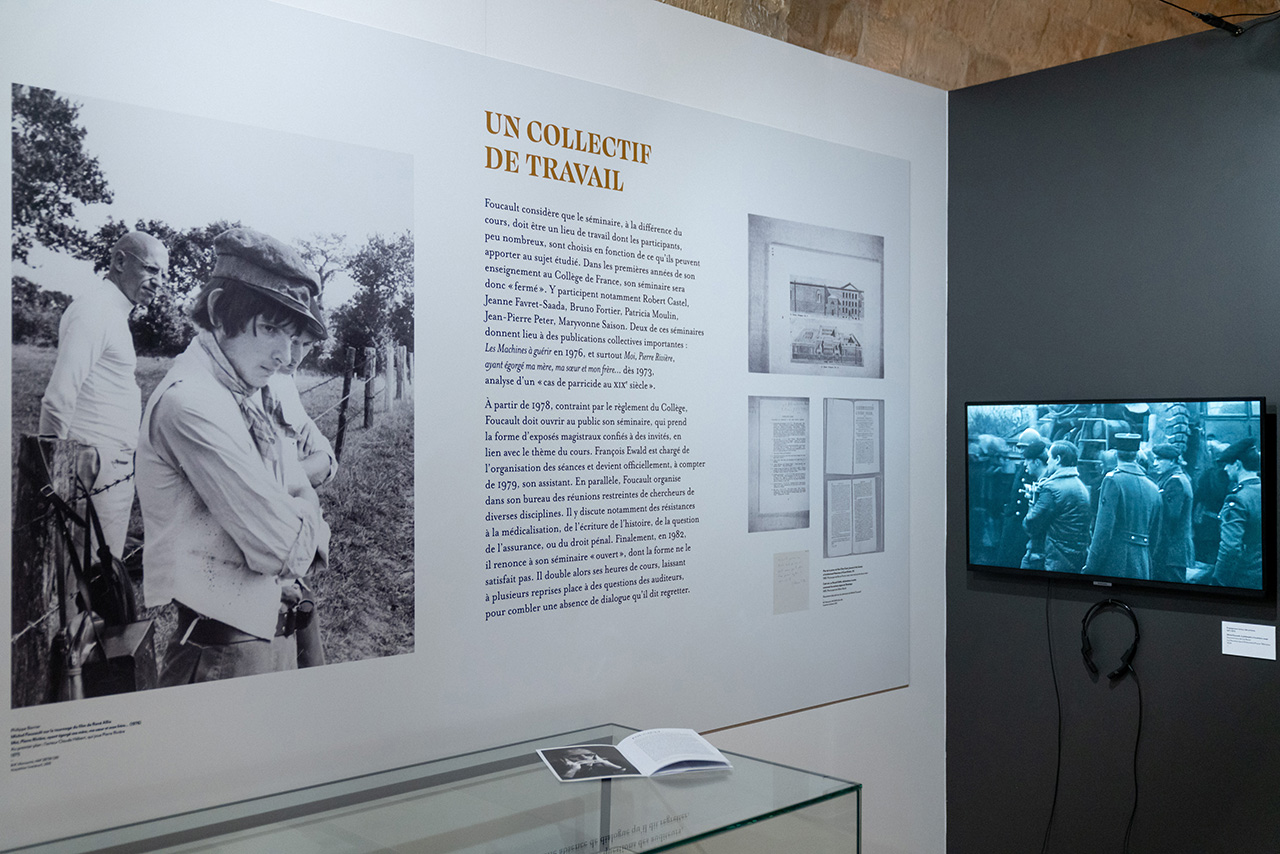
This session will focus on Michel Foucault’s seminars at the Collège de France, viewed as spaces for collective work and as venues for the production and circulation of knowledge. How were these seminars organized? What roles did they play in Foucault’s activities, and what projects emerged from them?

The first part of the session will offer a historical overview of these seminars, with the aim of reconstructing the various forms of intellectual collaboration that unfolded around them, where Foucault worked with individuals from diverse disciplines and traditions, such as philosophy, history, sociology, and anthropology, among others. The goal will thus be to highlight—beyond the seminars’ theoretical content alone—the research practices and forms of cooperation that made them possible.

This initial approach will be complemented by the testimony of Pasquale Pasquino, who actively participated in these seminars and worked alongside Foucault. His account will provide an insider’s perspective on the dynamics of these relatively informal gatherings—held with few authoritarian constraints—initiated by an intellectual who never thought of himself, much less presented himself, as either a mentor or the head of a school, but rather as someone who encouraged his intellectual friends to persevere in the will to know and the courage of thought, beyond all conformism and all rigid disciplinary constraints, without for that reason abandoning either conceptual rigor or a passion for knowledge attentive to the subjects of research.

Pasquale Pasquino

Pasquale Pasquino (Naples, 1948) is a Research Director Emeritus at the CNRS-EHESS and a Professor of Law and Politics at New York University. He has conducted research at the Collège de France, the Max Planck Institutes in Göttingen and Heidelberg, King’s College Cambridge (UK), the Hoover Institution at Stanford, and the European University Institute (EUI) in Fiesole, and has taught at several universities in Italy, Germany (Dresden), Hungary (Budapest, Central European University), the United Kingdom (London School of Economics), and China (Beijing, Tsinghua, and Beida). His publications focus on the history of political and constitutional ideas and on the comparative analysis of government institutions and constitutional courts.

Carolina Verlengia

Carolina Verlengia holds a Ph.D. in the history of political thought and is a member of UMR 5206 “Triangle—Action, Discourse, Political and Economic Thought.” Her dissertation, titled “The 1976–1979 Period in Michel Foucault’s Work: Reflecting on Current Events Between Philosophy and History,” was completed at the École normale supérieure de Lyon. She recently edited issue No. 100 of *Raisons politiques* , devoted to the dialogue between Foucault and Paul Veyne, in which she notably edited the transcript of a previously unpublished seminar held on May 17, 1979, in Foucault’s office at the Collège de France, centered on Paul Veyne’s essay “Foucault Revolutionizes History.”

Speaker(s)

Pasquale Pasquino

EHESS

Carolina Verlengia

ENS, Lyon