Since 2015, the Chair has been working on a comparative history of power in Western Europe from XIIIth to XVIth, with the aim of contributing to a critical archaeology of modern government. More than just a theory of sovereignty, the aim is to trace the social and cultural conditions of political inventiveness, which can also be those of contemporary re-actualizations. In other words, it's less a question of chronicling institutional constructs than of mapping the situations in which politics emerges - in places where we don't necessarily expect it, where it doesn't noisily express itself. Seeking regularities rather than rules, defending a style of inquiry rather than a method, these works aim to articulate the arts of governing and the arts of storytelling, in this respect overlapping with Patrick Boucheron's personal work on the writing of history.
It is in this spirit that the Chair welcomes the work of young researchers interested in these historical and historiographical issues, but also, more generally, in a certain way of articulating scholarly history and public history. Doctoral students working with Patrick Boucheron are attached to the LaMOP (Laboratoire de médiévistique occidentale) at the University of Paris 1 Panthéon-Sorbonne.)
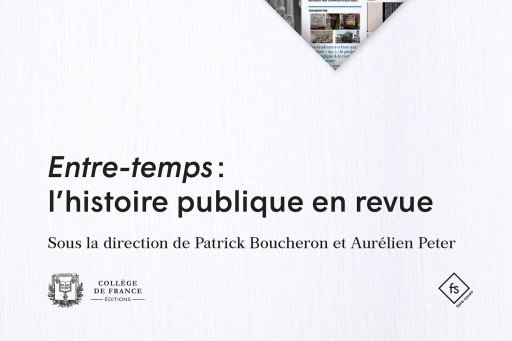
The digital journal Entre-Temps, which is attached to the chair and directed by its ATER, currently Aurélien Peter, is run by an editorial board reflecting this diversity of approaches. With the aim of contributing to the development of a public history service, it welcomes experimentation with new ways of writing history, linking the Chair's scholarly activities, developed in particular in lectures and seminars at the Collège de France, with Patrick Boucheron's other commitments, involving various cultural institutions in the public arena.