Physicists have discovered a surprisingly simple way to replicate one of the most fascinating models in modern physics—linked to black holes, quantum chaos, and exotic electronic materials—using ultracold atoms trapped by light. Rather than building an extremely complex system from scratch, the researchers show that simply “shaking up” a standard optical lattice slightly is enough to transform it into a faithful simulator of the Sachdev-Ye-Kitaev (SYK) model, a theoretical model known for its extreme and unusual quantum behavior.
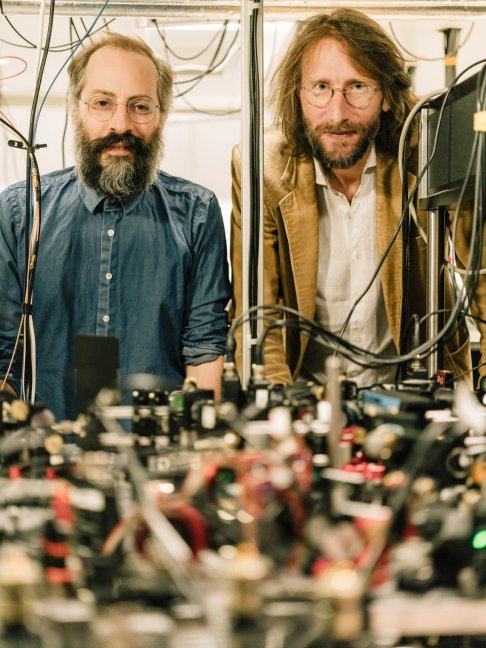
In their approach, the team—Nathan Goldman and Marco Schiró (Collège de France), along with Charles Creffield and Fernando Sols (Complutense University of Madrid)—periodically modulates the way atoms move from one site to another in the lattice. This carefully designed forcing suppresses the ordinary motion of individual particles and instead allows effective interactions involving many particles simultaneously to emerge, thereby mimicking the defining characteristic of the SYK model: a dense, quasi-random network of connections between all particles. Bien que le système obtenu ne soit pas parfaitement aléatoire, des calculs numériques détaillés montrent qu’il reproduit les signatures essentielles de la physique SYK, notamment un chaos quantique fort et un « brouillage » rapide de l’information – un comportement souvent associé aux trous noirs.
Importantly, this method can be implemented using current cold atom technologies, making it a realistic and experimentally accessible platform. It thus paves the way for studying phenomena that are otherwise extremely difficult to probe, such as how quantum information propagates in strongly interacting systems, or how complex quantum matter behaves far from equilibrium. More broadly, this work demonstrates how periodic forcing—the act of imposing a controlled rhythm on a system—can transform a simple experimental setup into a powerful tool for exploring some of the deepest ideas in modern physics.