News

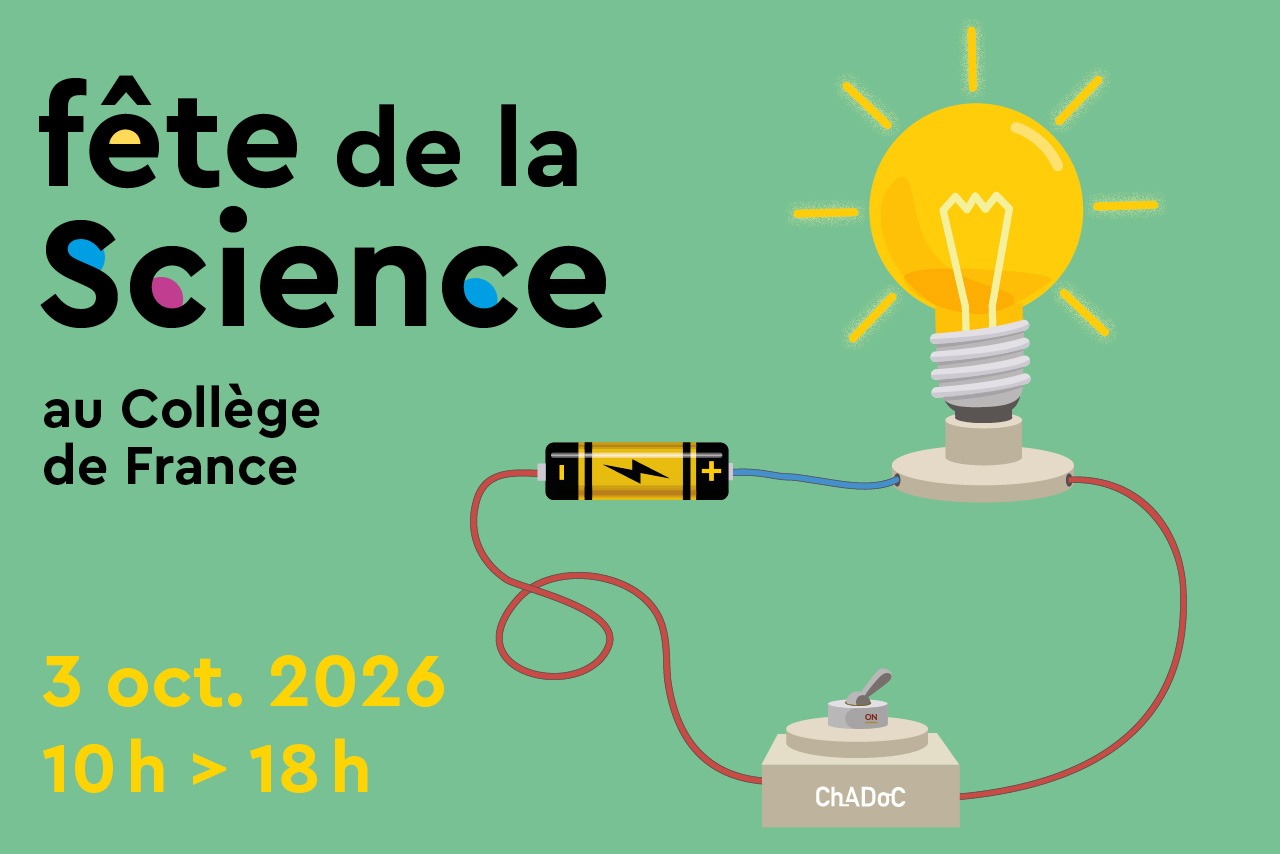
Science Festival 2026

Saturday, October 3, from 10 a.m. to 6 p.m. at the Collège de France

The ChADoC (Associate Researchers and Doctoral Students at the Collège de France) invite you on Saturday, October 3, 2026, from 10 a.m. to 6 p.m. (last admission at 5:30 p.m.), for a festive and engaging day dedicated to science.

Free admission; no registration required.

Young researchers will invite you to participate in fun and interactive experiments designed to introduce you to the major scientific disciplines that define the Collège de France’s excellence.

Special guided laboratory tours, available by registration, will also give you a behind-the-scenes look at research in biology and physics. Accompanied by the scientists who work there every day, you’ll dive into the heart of their activities and research.

Finally, the Collège de France’s pop-up shop will open its doors especially for this occasion. There you’ll find a selection of souvenirs as well as books published by The Collège de France Publishing Department.

On the program

Interactive Workshops

Experience immersive activities in neuroscience, microbiology, phylogenetics, electrochemistry, physics, mathematics, archaeology… and even codicology! In four different rooms, four major themes will be presented:

  • The World of the Invisible
  • Brain and Learning, Decoding
  • Energy and Matter
  • Biodiversity and Evolution

Detective Investigation

Given its success with young and old alike, a new detective mystery will be presented to test your deductive skills. By following the clues, you’ll use your scientific skills and logic to find the culprit! Get ready to put your detective skills to the test to recover the stolen bust of Claude Bernard…
Suitable for ages 8 and up.

Lab Tours

Advance registration required. Recommended for ages 13 and up.

  • The Kastler-Brossel Laboratory is a joint research unit of the CNRS, the Collège de France ( Institute of Physics ), Sorbonne University, and the École normale supérieure, dedicated to the study of quantum physics. Here, researchers manipulate atoms under extreme conditions to study their behavior when they are isolated and near absolute zero. Come visit one of the experimental labs to discover the equipment researchers use to create these extraordinary conditions.
  • The Interdisciplinary Center for Biology Research (CIRB) at the Collège de France is home to numerous research teams working on a variety of topics. We invite you to step inside two of these laboratories and discover how microbiologists and neuroscientists conduct their experiments.

What’s it like to work in research?

Are you wondering what kind of education is required to become a researcher? During four Q&A sessions, the ChADoC members will share their career paths and openly answer all your questions about scientific careers.