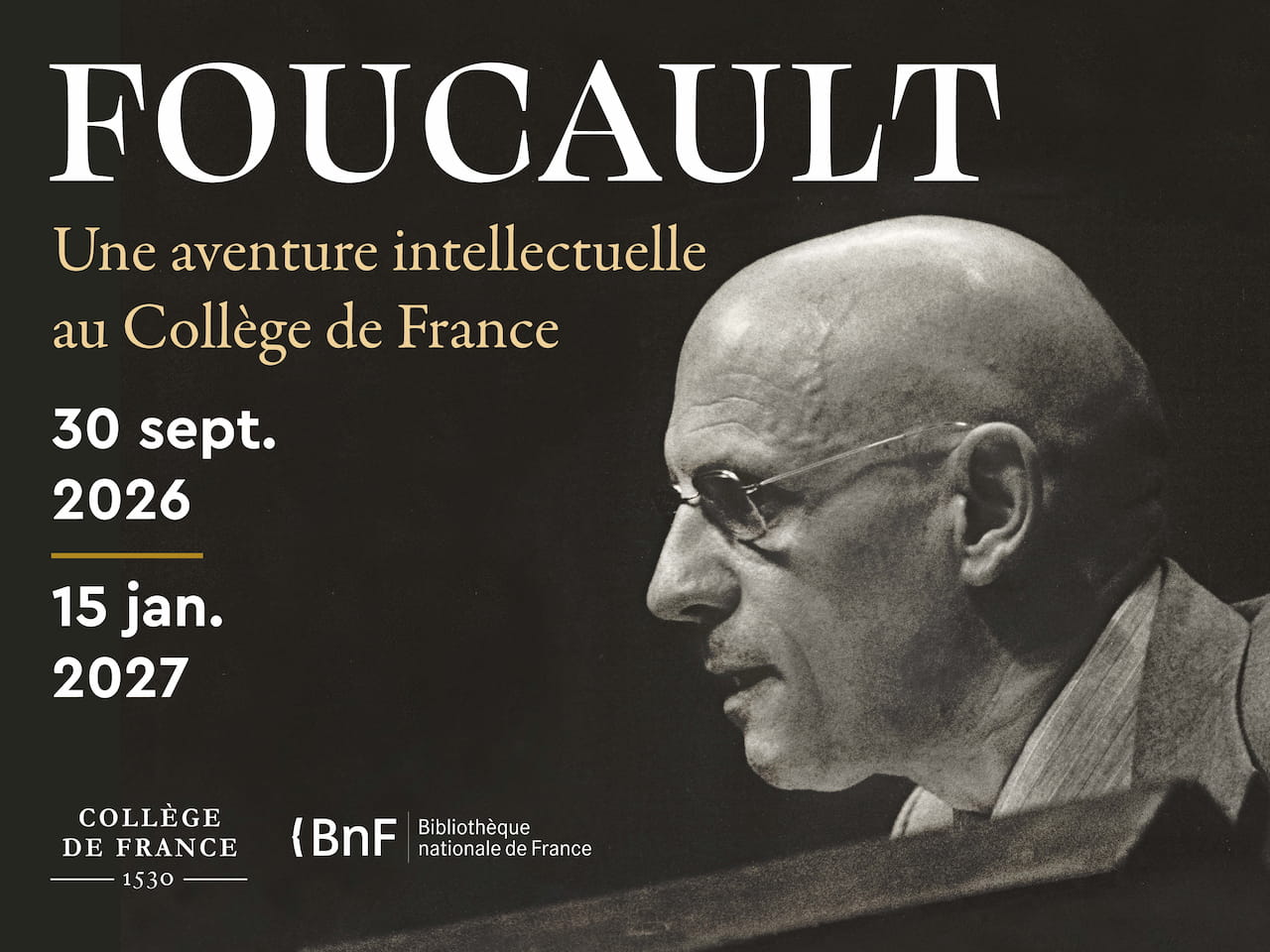
From September 30, 2026, to January 15, 2026, the exhibition “Foucault: An Intellectual Adventure at the Collège de France” explores the career of Michel Foucault (1926–1984) at the institution where he taught from 1970 to 1984. To mark the centennial of his birth, previously unpublished manuscripts, archival materials, and audio and video recordings trace the evolution of a body of thought that remains deeply relevant today.
On April 12, 1970, the philosopher Michel Foucault—the celebrated and controversial author of *Madness and Civilization* and *The Order of Things* —was elected to the Collège de France to hold the chair in the History of Systems of Thought. This election was by no means a foregone conclusion for a scholar who had initially taught psychology but rejected disciplinary allegiances, and whose career was already marked by outbursts and strong political commitments. It marked the beginning of an intellectual journey spanning nearly fourteen years, the reverberations of which can still be felt today, as evidenced by the influence of concepts such as “governmentality,” “biopolitics,” “pastoral power,” and “regime of truth.”
His lectures at the Collège de France were much more than a rough draft of his written work. They allowed him to explore new fields and test new hypotheses. Their influence began very early on with public success and the free circulation of recordings and typewritten transcripts. It quickly spread beyond France’s borders, thanks to an international audience and the philosopher’s numerous stays abroad, notably in the United States, Brazil, and Japan. The posthumous publication of his lectures, followed by their translations around the world, established them as a body of work in their own right, as widely read and cited as the books published during his lifetime. They thus gave his thought an unexpected second life, as they renewed the understanding of the issues he addressed and shed light on his method.
The approximately one hundred items on display—unpublished manuscripts, personal belongings, and audio and video archives—trace a dazzling international career cut short too soon, leaving behind a considerable body of scholarly work. In particular, the exhibition sheds light on the coherence and enduring nature of a constantly evolving body of thought that rejected categorization. It recreates this journey within a network of friendships and peers at the Collège de France, as well as through strategies and struggles beyond its walls, reminding us that knowledge is also a matter of power.
An exhibition organized by the Collège de France in partnership with the Bibliothèque nationale de France.