News

Foucault: His Middle School Years

Interview
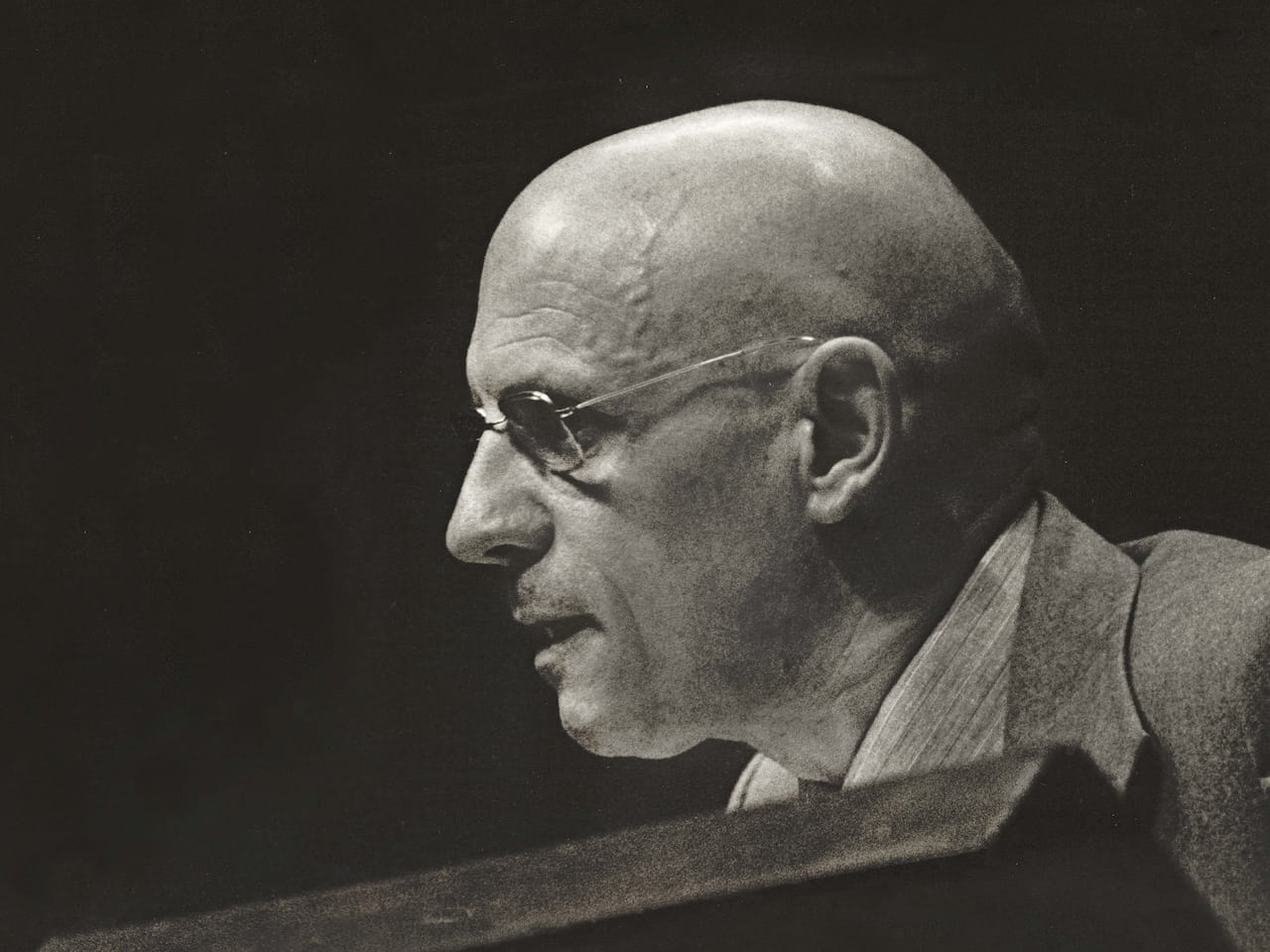
Michel Foucault - © BnF.

To mark the centennial of Michel Foucault’s birth, the Collège de France, in partnership with the Bibliothèque nationale de France, will present the exhibition “Foucault: An Intellectual Adventure at the Collège de France” from September 30, 2026, to January 15, 2027 .

Professor Didier Fassin, the exhibition’s curator, explores a body of thought that has lost none of its critical force and invites visitors to rediscover this philosopher and his fourteen years of teaching at the Collège de France.

Beyond the anniversary of his birth, why did you feel it was necessary—in addition to the courses and seminars you’ve taught this year—to organize an exhibition on Michel Foucault?

Didier Fassin: Not only is Michel Foucault the most cited author internationally in the social sciences and humanities, but his presence has left an indelible mark on the contemporary history of the Collège de France through the originality, creativity, and commitment evident in his teaching. Without offering an exegesis of his work or a hagiography of the author, it seemed important to me to honor his memory—and above all, to emphasize just how relevant his thought remains for understanding the many challenges and formidable dangers facing our world.

At a time when Foucault has become a global authority in the humanities and social sciences, how can we move beyond mere celebration of his legacy to rediscover the critical force of his intellectual enterprise?

After his death, his work was, particularly in France, relatively neglected, before being increasingly invoked over the years in various contexts, to the point of being appropriated—notably in the United States—by libertarian ideologies to which he would never have subscribed. There is, therefore, a twofold risk: that of a passing fad and that of a misappropriation of his thought. To avoid this, we must adhere to his rigorous method while remembering his vision that his intellectual output should serve as a toolbox from which anyone is free to draw in order to study all manner of subjects.

Why does Foucault’s tenure at the Collège de France, from 1970 to 1984, remain so central to understanding his intellectual work?

The course was a performance, as he liked to say, but above all it was a ceaseless exploration of new avenues of thought, since the rule at the Collège de France is that the curriculum must be different every year. Michel Foucault took this requirement very seriously, to the point that the reorientation of his themes and theories may have unsettled his colleagues and students—such as his return to Greco-Roman antiquity and his study of care of the self during his final years. The posthumous publication of the lectures—which is a welcome departure from his will—has thus completely transformed our understanding of his thought, which had previously been shaped solely by the books published during his lifetime. Moreover, the lectures reveal the freedom of a thought process in motion that the written form tended to temper.

What do you think the enduring success of his teachings—particularly the publication by Éditions du Seuil of his lectures at the Collège de France up through 2015—says about the relevance of his thought today?

Not only is his success enduring, but his influence is growing, as revealed by statistics on citations of his work in contemporary scholarship. If this is the case, it is because his critical approach—paradoxically inspired by both Kant and Nietzsche—is indeed an invitation to question the obvious, not to take for granted the way the world is presented to us, to examine the degree of contingency and arbitrariness that characterizes it, and to ask ourselves how it might be otherwise.

How did you seek to highlight the Foucault as a teacher—the one at the Collège de France—in contrast to the public intellectual?

Michel Foucault draws a striking distinction between the theoretical—often scholarly—work he presented at the Collège de France and the—sometimes radical—positions he defended outside of it. There may be an echo between the two, as when he taught his courses “Penal Theories and Institutions” and “The Punitive Society” during a period when he led the Prison Information Group and frequently spoke out in the media and on the streets; yet he was careful to interrupt the chronology of his research on the nineteenth century, distancing himself from the prison revolts of his own time. For his audience, however, the investigation into the penal system and the unequal treatment of illegal acts resonates with the present.

What do the audio archives featured in the exhibition reveal?

We wanted visitors to be able to appreciate Michel Foucault’s tone of voice and diction. To that end, headphones will be available for listening to an excerpt from one of his lectures delivered on our campus. Furthermore, the complete recording of his lectures—available on the Collège de France website, with annotated excerpts accessible via France Culture podcasts—showcases his instantly recognizable voice, along with the agility of his discourse and the humor in his remarks. It also reveals just how much he conceived of his lessons as an exchange with his public—a form of dialogue with silent, yet very much present, listeners.

What will this exhibition contribute to the traditional reading of Foucault?

The exhibition’s itinerary, which will feature numerous original documents, traces his years at the Collège de France, from his election to his untimely death, showcasing his prolific intellectual output while highlighting his friendly relationships with colleagues and his many appearances around the world. Five lectures, as well as a theatrical performance at the Bibliothèque nationale de France, will take place throughout the duration of the exhibition. These events will offer a glimpse of Michel Foucault at work, both in his preparation of lectures and in the discussions within his seminar. These public events will thus place Michel Foucault’s years at the Collège de France back into their historical context.