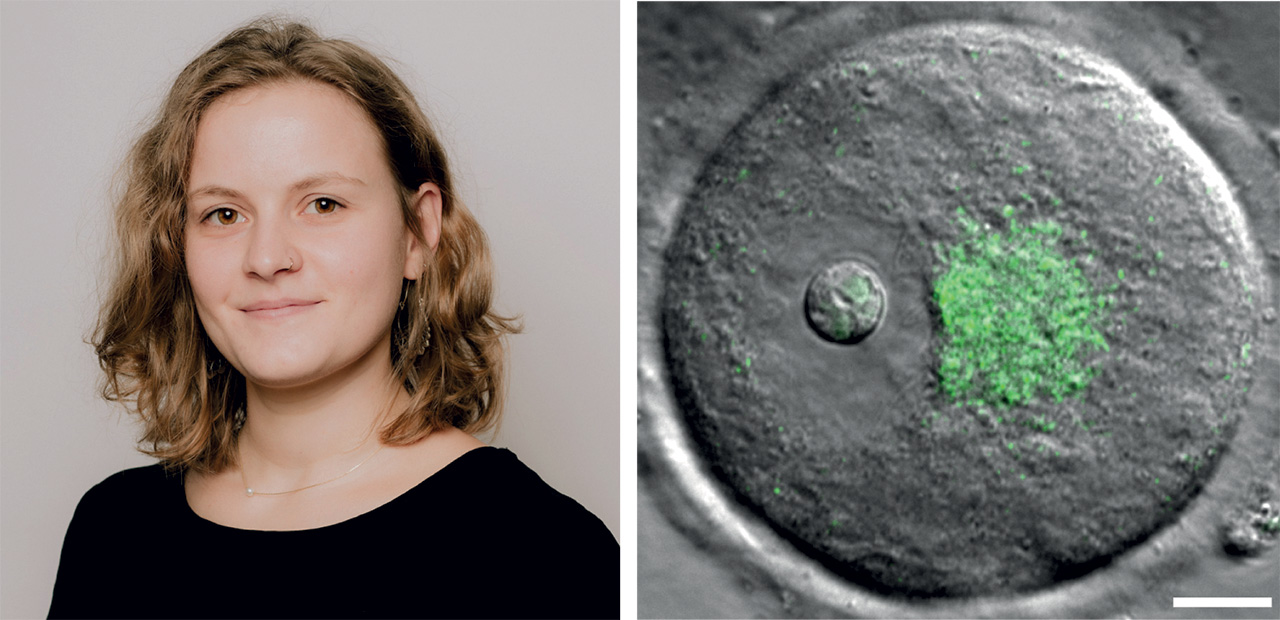
This discovery stemmed from an observation made by Noemi Zollo—a doctoral student co-supervised by Maria Almonacid and Marie-Hélène Verlhac at the CIRB—of an unusual concentration of RNAs near the nucleus, detected using a specially designed probe, in small mouse oocytes but not in large ones. This structure piqued Noemi’s curiosity, and very quickly she observed that mitochondria were also accumulating in this region, reminiscent of a structure known as the Balbiani body, which is present in vertebrate oocytes at the very beginning of their development. The goal of Noemi’s dissertation was therefore to characterize and identify the function of this structure—which we named the Zollo body— that appears at the end of oogenesis. Using interdisciplinary approaches and thanks to numerous collaborations, notably with Elvan Böke’s team at the CRG in Barcelona and with Christopher Thomas’s team at the IBDM in Marseille, Noemi demonstrated that the Zollo body is a superorganelle containing numerous organelles—mitochondria, the Golgi apparatus, the endoplasmic reticulum, lysosomes—as well as RNA-associated proteins.
This superorganelle is held together by microtubules as well as a protein matrix, thereby forming a supercondensate, similar to the Balbiani body. This property allowed Noemi to mechanically isolate the Zollo body from the oocytes and thus identify the RNAs and proteins that constitute it, through RNA sequencing and mass spectrometry, respectively. This technical feat led to the identification of key proteins, such as the DDX5 helicase, whose pharmacological inactivation causes the rapid dissolution of the Zollo body within the oocytes. The dissolution of the Zollo body within the oocytes inside their ovarian follicles is associated with a halt in the growth of both the follicle and the oocyte. The Zollo body is the site of significant protein synthesis—unlike the Balbiani body, which serves as a storage and protective site for maternal RNAs—and its presence is necessary for the growth of the oocyte in size, which accelerates toward the end of oogenesis. Thus, although the Balbiani body and the Zollo body are similar in their organization, they perform very different functions in oogenesis, and at distinct stages—the former at the beginning and the latter at the end, respectively. Furthermore, a structure resembling the Zollo body appears to be present in the human oocyte, suggesting a function that has been conserved throughout mammalian evolution, enabling oocytes to rapidly reach an optimal size—which is very large compared to most cells in our body. Indeed, compared to the male gamete—the sperm—the female gamete is an enormous cell, whose maternal reserves accumulated during its growth in size support the early stages of preimplantation embryonic development. Thus, the transient formation of the Zollo body is a key event in the development of mammalian oocytes, enabling the female gamete to establish its developmental potential, which is expressed after fertilization.