This article is a simplified transcript of the remarks made by Florence Leray, a philosopher, professor at the Catholic University of Lyon, and doctoral candidate (under the supervision of Sylvain Piron, EHESS), during the symposium “Future: How Long Must We Wait? ” held on May 10, 2022. Subheadings have been added to make the text easier to read. Ms. Leray’s remarks followed a presentation by Sylvain Piron, who began by introducing the concept of “prophecy.” The video of both presentations can be found at the end of this text.
“Since the publication of the Meadows Report 50 years ago, the most shocking predictions have often been dismissed as apocalyptic prophecies. The fear of causing shock—and of being seen as harbingers of doom—can lead to the worst-case scenarios being swept under the rug, when perhaps we should instead embrace their prophetic nature.
Thus, in September 2019, French laboratories (including the CNRM—the National Center for Meteorological Research, a research unit of Météo France and the CNRS—and the IPSL, the Pierre Simon Laplace Institute) involved in harmonizing global climate models as part of the CMIP6 project (Coupled Model Intercomparison Project) published an eye-opening report.
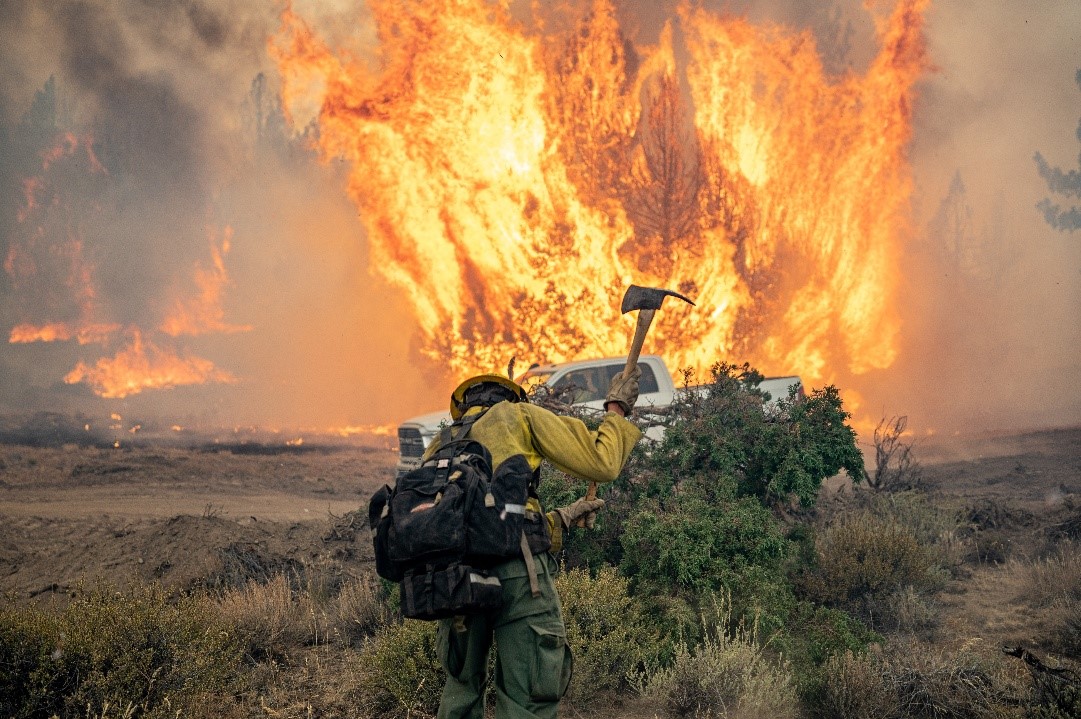
According to this report , rapid economic growth fueled by fossil fuels could lead to a 7 °C increase in the global average temperature compared to pre-industrial levels by 2100. For France, this would mean heat waves lasting all summer, with temperatures exceeding 50 degrees, as was the case in Pakistan in mid-May 2022. Droughts would be long and widespread: the Garonne River, for example, could run dry for several months as early as 2070. Agricultural practices would be severely disrupted, and forest fires would become more frequent. As early as 2080, the Arctic could lose its summer sea ice. Sea levels could rise by more than ten meters, submerging many island nations and coastal cities and forcing millions of people to flee.
In short, it would be a veritable apocalypse.
These data informed the first part of the IPCC’s Sixth Assessment Report , published in August 2021, in which the worst-case scenario has indeed been revised downward to +4 degrees. This is the temperature increase we will reach by 2100 if we continue to behave as we do today—and it portends a world just as terrifying as the one in the +7-degree scenario…
A Heuristic of Fear
Do these worst-case scenarios have an educational value? In other words, is there such a thing as a heuristic of fear? Hans Jonas believes so. As he explains in The Imperative of Responsibility , published in 1979, fear is a means of preventing future harm by imagining its occurrence. The heuristic of fear is thus both rational and emotional: rational, because it draws on intelligence to assess future risks and their consequences; emotional, since it stems from fear, the quintessential emotion of anticipation. However, is fear truly effective in spurring people to take action?
The problem, as I explain in my book The Denial of Global Warming, published in 2011, is that fear can be paralyzing when reality is perceived as too distressing; a powerful mechanism of repression then kicks in, and reality is denied. In fact, today, one in five French people still does not believe in global warming… Yet the reality is clear: the most ambitious scenario proposed by the IPCC—the one in which warming is limited to 1.5°C—has virtually no chance of coming to pass. Indeed, that would require a drastic reduction in global emissions starting today at a very rapid pace. However, the economic, social, and political likelihood of this happening is zero.
All our hope therefore rests on the second scenario—the one at plus 2 °C—which would avert an apocalyptic world. The probability of this second scenario is low, but not zero. However, for it to have any chance of coming to pass, it requires the implementation, over the next eight years on a global scale, of very strict policies restricting the use of fossil fuels and the establishment of an effective climate policy. But how can we achieve this, given that living in a world where global warming reaches 2 °C still means we must adapt to major upheavals?
Focusing on Desire
Perhaps we need to focus on desire rather than fear. Indeed, after several years of workshops with my students at the Catholic University of Lyon, based on a role-playing game I created about a resilient city by 2100, I observed that the desire to keep their city alive—the goal of the game is to ensure that their city does not collapse by 2100 despite various disasters inspired by IPCC reports that I subject them to—led to two types of behavior among the teams of players: either aggression or cooperation. This essentially boils down to the survival instinct.
For some students, the emotional toll was even quite intense: tears, anger, elation, rebellion… Yet I ultimately observed that the winning teams were those that had formed alliances with other cities, whether against a common enemy or by exchanging new technologies. How, then, can we help humanity foster alliance rather than attack?
The main lever at our disposal undoubtedly lies in the fact that moral consciousness is based on emotions, particularly empathy (see, in this regard, the work of neurobiologist Antonio Damasio at the University of Southern California in Los Angeles). A rationality that is completely “de-affected”—the past participle “affected” here meaning “moved”—would be monstrous. This is why a true civilizational shift can only take place by resonating with, or showing “empathy” toward, living beings—today, but also tomorrow: we must think of future generations, as Hans Jonas says, who have the right to live on a habitable Earth. Thus, starting today, we can conceive of new categories that include humans, plants, and animals within ecosystemal frameworks (see, in this regard, the proposals of Philippe Descola ).
Thinking about the future requires, in fact, connecting different disciplinary fields, because the evolution of natural ecosystems cannot be separated from issues of poverty, urbanization, energy production methods, agricultural practices, and so on—that is, from the way we inhabit the world. The issue of inequality is particularly important.
Indeed, according to a scientific study published in 2014 in the Elsevier journal Ecological Economics under the leadership of mathematician Safa Motesharri, the overexploitation of natural resources combined with excessive disparity between the rich and the poor leads to the collapse of a civilization. This is what the model known as HANDY—short for Human And Natural DYnamical—reveals. Thus, according to the researchers, in the past, several empires have collapsed due to the blindness of their elites, who, right up to the end, believed themselves to be protected and refused to reform their systems of social organization.
Collapsology, a transdisciplinary field, is particularly valuable for taking all of these dimensions into account. One of the questions it raises concerns threshold effects: at what critical threshold can a system collapse? In my view, it would be very interesting to examine this body of work in order to study, conversely, positive threshold effects: at what point can a system begin to recover? This would enable us to implement actions that foster resilience. We know, for example, that if 25% of the population adopts new social behaviors, those behaviors will become the social norm!
Life on Earth risks becoming a living hell, when we could instead turn it into a paradise. It is in this sense that new, positive, prophetic narratives could help accelerate a just and desirable ecological transition for all—or else face the collapse of civilization.”