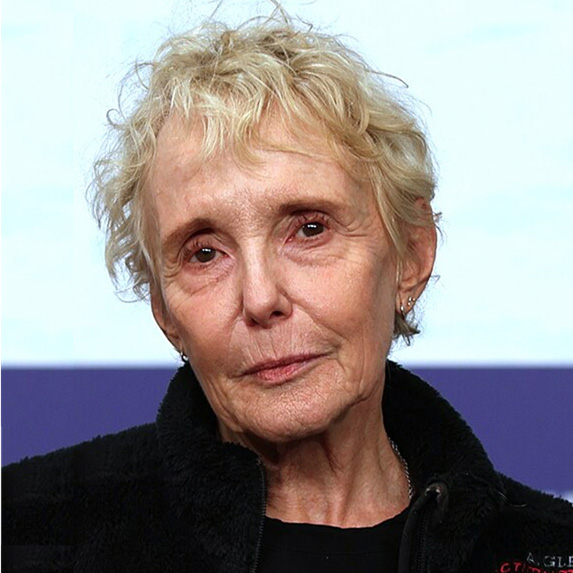
Since her debut feature film *Chocolat* (1988), inspired by her childhood in Africa, the director Claire Denis has become a leading figure in the world of cinema. Unconventional, sensitive and politically engaged, her films explore colonial legacies, identities and the complexity of relationships. Rich and multifaceted, her body of work comprises sixteen feature-length fiction films, including *Nénette et Boni* (Golden Leopard at Locarno, 1996), *Beau Travail* (1999), *Trouble Every Day* (2001), *White Material* (2009), *Un beau soleil intérieur* (2017), *High Life* (2018), *Stars at Noon* (Grand Prix at the 2022 Cannes Film Festival), and *Avec amour et acharnement* (Silver Bear at Berlin, 2022).
Claire Denis has been invited to hold the annual Cinema Chair for the 2026–2027 academic year, established in partnership with the Centre national du cinéma et de l’image animée (CNC).
Was becoming a director something that came naturally to you?
Claire Denis: No, I did hesitate a little before believing that I could make films. I grew up in Africa, far removed from that world. I simply knew from my mother and one of my grandfathers that the most wonderful thing in the world was going to the cinema. But I didn’t really know that pleasure myself. It was to such an extent that when I was little, in northern Cameroon, my mother would read me stories in bed, but she would also tell me about films. I started watching films when I was 10 or 11, though they were usually American war films. That’s what we’d been given… But there were no cinemas. So I felt that going to the cinema was an exceptional, almost magical experience, and I wasn’t even sure I’d ever get to have that experience.
I really discovered it as a teenager, when I arrived in France. My school’s film club was very important to me, giving me the pleasure of discussing films after watching them. I was still very much in the dark, though, and it was through friends at school that I learnt about a film school, the IDHEC [Institut des hautes études cinématographiques, which merged with La Fémis in 1986]. I sat the entrance exam, but it seemed impossible to me that I could pass it. The school struck me as so sophisticated; it seemed to be for people who already had a deep understanding of cinema: they went to the Cinémathèque, read *Cahiers du cinéma*… And I, I had such a limited cultural background! I lived in the suburbs; I felt a bit out of the loop. I was so convinced that I wasn’t cut out for that school – or even for a career in filmmaking – that I went off to work in Germany with my partner, who was a photographer, without even checking the exam results. Fortunately, a friend tracked me down to tell me I’d been accepted. I rushed back straight away!
After you joined IDHEC, how did you make your way in the world of cinema, right up to directing your first feature film, *Chocolat* , in 1988?
When I started at the school, after May ’68, I realised it had been completely overhauled by the students. Louis Daquin was the new director. There were no longer any teachers as such, but film technicians who came to give lessons for a fortnight, three weeks, two days… That suited me, as I felt I could engage with them, given that I didn’t share the same background as my classmates. As a student on the Directing course, I felt a bit like an ‘outsider’. There were only boys. Louis Daquin was very supportive. He found me work placements, but for a young woman at the time, directing wasn’t the direct route to a career in cinema! Women tended to be script supervisors or work in editing, for example. So I got my start in cinema by working as an assistant, but not as a director. I was lucky enough to work with directors I admired greatly. It was marvellous. From Jacques Rivette to Wim Wenders, I felt as though I’d stepped into a world of my own – not the film industry, but a place where I belonged. And besides, those people told me so. I was appreciated for who I was, and looked after. Jacques Rivette really encouraged me to write screenplays. I was a bit vulnerable, because my film projects were set in Africa and that wasn’t straightforward for producers: they would have preferred it to be shot in Paris, in a room or two… But I stood my ground. I’d given it a lot of thought whilst working on the film *Paris, Texas* : I’d done all the location scouting with Wim Wenders and travelled through landscapes straight out of American cinema, but I remained certain that for my film, I had to go to Africa. My earliest memories of being a thinking, living person were from there. I’d lived through the end of colonial rule there and, like many young white children, I’d sensed just how different it was to be born white or to be born black. In the end, they put their trust in me for *Chocolat *.
That first film attracted a great deal of attention: it was selected for the official competition at the Cannes Film Festival and nominated for a César. Since then, you’ve been directing with impressive consistency, and your body of work is now very rich. Given the well-known difficulties of making films, have you ever gone through periods of doubt or discouragement?
To be honest, when I made my first film, I thought I might never make another one. Its success opened a door for me. All of a sudden, I was able to write another screenplay and make the film I wanted to make, with producers who were interested in it. I was also offered a few film projects with screenplays that had already been written. I was flattered in a way, but I didn’t really feel up to it; I needed to have had some hand in the script… Working with directors like Rivette, Wenders or Jarmusch – who operate somewhat outside the mainstream film industry – I think I realised straight away that my original screenplays wouldn’t immediately attract a major production company that would jump at the chance to make the film. So I’ve never been discouraged by the difficulties. In fact, it’s always difficult, but I believe that to make the films I want to make – the ones we’re partly responsible for conceiving, the ‘auteur films’ as they’re called with that awful term – you have to pay the price. It’s not something that falls from the sky. And on the contrary, even when money was tight, I’ve always had producers who believed in me and supported me.
Ever since you started out, you’ve very often worked with the same team. We’re thinking in particular of Agnès Godard, the director of photography, and Jean-Pol Fargeau, the playwright and screenwriter, who have worked with you on numerous films…
Agnès Godard and I met at IDHEC. Neither of us was particularly talkative, but we felt we understood each other when it came to talking about cinema, a shot or an image. So when I made my first film, I asked Agnès to be the director of photography. As we were shooting in northern Cameroon, my producers were a bit apprehensive: there was already a female director, and now a female director of photography on top of that! So they asked me to hire a male director of photography. I had a friend, Robert Alazraki, who accepted my offer, knowing that Agnès would be framing the shots and that she would still be my partner on the film. Then we worked together a great deal, she and I. Those were always wonderful moments for us, because each time, we prepared for the film as if we were starting from scratch. Agnès and I never thought we had to find a style, but rather a way of expressing our thoughts and feelings. That was our quest. We didn’t really care much about style.
As for Jean-Pol Fargeau, he’s an extraordinary colleague. I met him in Marseille whilst going to see a play he’d written and was performing in. At the time, I was starting to work on the screenplay for *Chocolat *. I told him about it; he was very interested and asked if he could be involved. I’d received a bit of funding from the CNC, so the two of us went to Cameroon to scout locations, then we came back to work in Marseille. From then on, we wrote a lot of screenplays together, right up to *High Life *. We had a particular way of working: we had to be together; we couldn’t work remotely. He’d come to Paris or I’d go to Marseille. We had to live in the same house, have our coffee together in the morning, eat the same meals, go for walks together in the afternoon… This allowed us to be completely on the same wavelength, to visualise the characters together, and to avoid pitting one idea against another but instead to truly find common ground in our ideas. This sharing of daily life, of places, of reading material, of music… It was a whole experience that I found utterly enchanting.
You’ve explored very different cinematic worlds and genres – from drama to science fiction, via horror. Despite the diversity of your films, could one say that there’s always a committed perspective, one that denounces or at least highlights violence? Colonial violence, racist violence, violence against women…
Yes. Because that’s what I see in life. Well, we all see more or less the same things, but we don’t all experience them in the same way. I think that right now, for example, we could say we’re all aware that violence is everywhere. But we each deal with it as best we can, and express it as best we can.
I depict violence because it’s something that’s there. It’s there when you start telling a story… The beginning of a script is a small fragment, a tiny spark. It’s not a ready-made story that just happens out of the blue. They’re small elements which, little by little, will take shape, and which I’ll be able to latch onto… I’m not a very violent person; I really love gentleness, friendship and tenderness, but I don’t feel that the world is steeped in that gentleness. Also, I sometimes feel that cinema likes to use violence to create action. For example, in action films, violence can become a way of captivating the audience. It’s like an attraction. I wouldn’t want to do that; I’d prefer violence to be a bit more subdued within the film.
Your opening lecture is entitled ‘Doing Better’. What do you mean by that?
‘Doing better’ are the words that sprang to mind, if I may say so, when I was offered this opportunity and asked for a title. When you make a film, for me – though probably not just for me – there’s a kind of inner, sensitive mechanism that kicks in… You tell yourself it will be better than the previous film. It’s something that drives you to go further. Once the previous film is finished, it fades into the background a little, and the next one has to surpass it. To make another film, something has to crystallise within me; otherwise, I’m not interested. For me, it’s not a job. I’ve never seen it as a career, nor as a job.
If making films isn’t your job, what is it to you?
It’s my life.
Interview by Salomé Tissolong, journalist