Yola Gloaguen
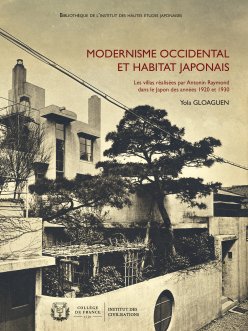
Western Modernism and Japanese Housing: The Villas Designed by Antonin Raymond in Japan in the 1920s and 1930s
This book examines the life and work of the Czech-born American architect Antonin Raymond (1888–1976) in interwar Japan. Initially invited in late 1919, along with his wife and collaborator, the artist and designer Noémi Pernessin-Raymond (1889–1980), to join Franck Lloyd Wright’s (1867–1959) Tokyo team, which was designing the new Imperial Hotel, Raymond founded his own firm in 1921 and embarked on a prolific career in the Japanese capital. During the interwar period, he developed an architectural design process that drew both on the theoretical and technical innovations of Western modernism and on local spatial culture and construction techniques. Like many of his European and American peers who were pioneers of the Modern Movement, Raymond used the medium of the architect-designed single-family home to experiment with and give shape to this approach, with the support of his team.
Organized into three parts, this book explores the various stages in the development of this architectural design process. It opens with a biography tracing Raymond’s journey from his native Bohemia to Japan, via the United States, during the turbulent yet fruitful period of the late nineteenth and early twentieth centuries. It continues with an examination of the circumstances under which Raymond established himself as an independent architect in Tokyo, built a team, and acquired a number of theoretical and technical tools necessary for modern architectural practice in the Japanese context of the 1920s and 1930s. Finally, a selection of villas built in the capital and surrounding resort destinations between 1921 and 1938 is presented. A detailed architectural analysis of these residences, built for an elite Japanese and Western clientele, reveals the various stages of the architectural design process that enabled Antonin Raymond—with the help of his team, which was initially international and later predominantly Japanese—to create architecture that was both universal and rooted in the local context. Through the lens of architecture, this work explores the issues and challenges raised by the process of modernization that characterized Japan’s history during the first half of the 20th century.