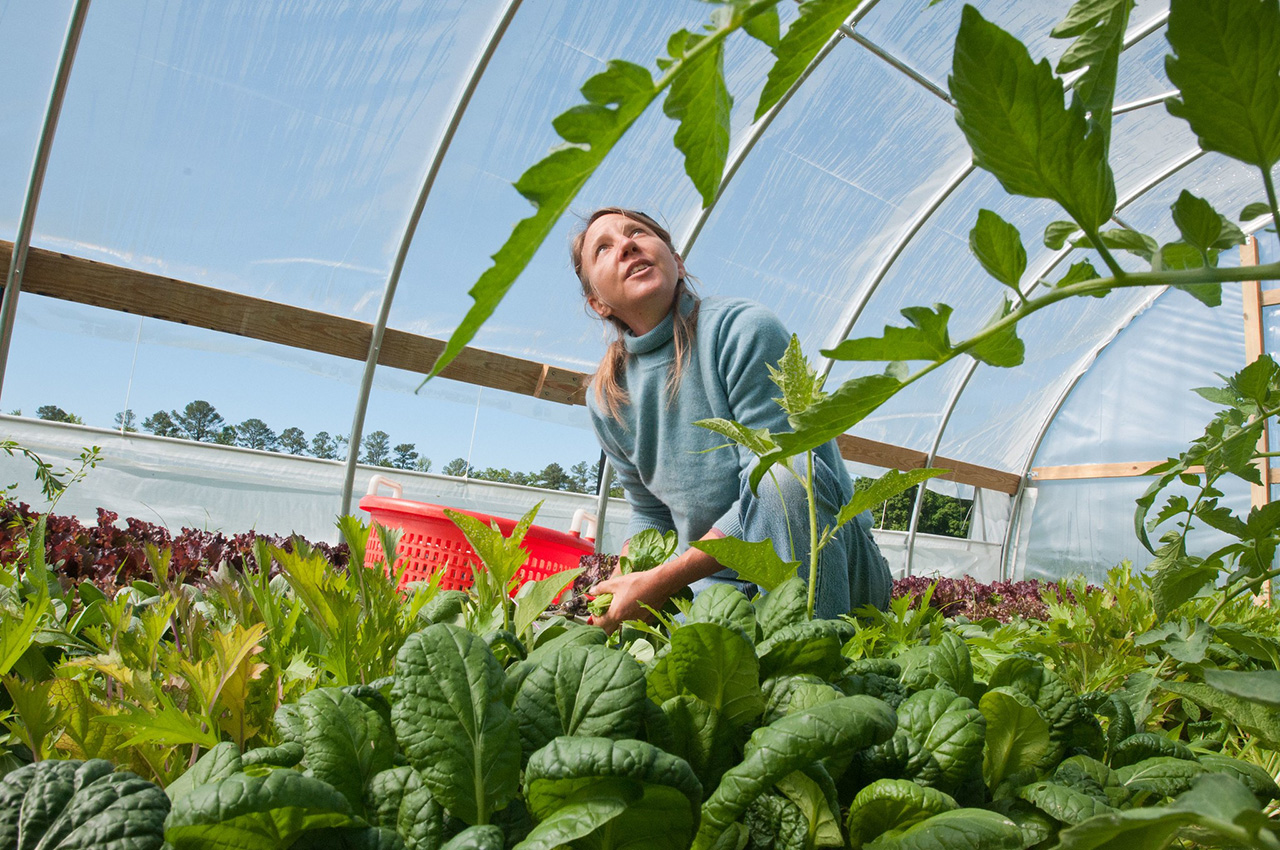
In the face of climate change, researchers from a variety of fields are working to understand and anticipate changes in agricultural practices. Brought together under the MATS project—an acronym for “Modeling Agricultural TransitionS” — they are adopting innovative approaches.
On this May morning, they are gathering at the entrance to the Collège de France. About ten researchers have come together for a seminar as part of the MATS project, which stands for “Modeling Agricultural TransitionS.” Hailing from universities in France, Switzerland, the Netherlands, and the United States, these scientists work across a range of disciplines. Among them are researchers in finance, mathematics, econometrics, agricultural and environmental economics, and specialists in the agri-food sector… But they are all working here on the same issue: the evolution of agricultural practices in the context of climate change. The project is led by mathematician Pierre-Louis Lions, a professor at the Collège de France and holder of the Chair in Partial Differential Equations and Applications; Delphine Lautier, a professor of finance at Paris Dauphine University – PSL; and Bertrand Villeneuve, a professor of economics at the same university. Launched in 2023, the research will be supported for three years by the Avenir Commun Durable initiative.
The Necessary Evolution of Agricultural Practices
The project’s starting point is a simple, albeit concerning, observation: the world’s population is projected to reach 9.7 billion people by 2050. To keep pace with this growth, food production will need to increase by 70%... The agricultural sector also plays a central role in the ecological transition, due to the greenhouse gas emissions it generates and its impact on water resources and land use. At the same time, climate change is having an increasing impact on agriculture and the lives of farmers themselves. For all these reasons, agricultural practices must evolve.
A Complex System to Study
The MATS project team will therefore seek to understand and anticipate this necessary evolution, but the task is not an easy one. Researchers must first identify the many stakeholders in this sphere, as well as the interests of each. These include, among others, farmers, consumers, residents, political authorities, and regulatory bodies... The scope of this research extends far beyond agricultural production alone: it includes other markets directly linked to it, such as water, energy, and financial protection (insurance or guarantee funds). The goal is to understand the interactions between these stakeholders—whether strategic or involuntary—by modeling certain aspects of these interactions. These models should also make it possible to predict the impact of certain regulatory measures by conducting simulations that incorporate variables such as climate data.
“For now, we’re trying to grasp some little-known aspects of how the agricultural sector works, ” explains Julien Ling, who holds a Ph.D. in finance. As part of a postdoctoral fellowship at the Collège de France, he has been working alongside Delphine Lautier on the MATS project since 2023. “And there’s still a lot to understand,” he continues . “To do this, we use very advanced tools and collaborate across research groups. Seminars allow us to share the progress of our work and can lead to new people joining a group if someone wants to participate in a specific project...”
A Wide Range of Topics
The MATS project provides an opportunity to explore a wide range of topics. Each researcher or group of researchers contributes their own perspective, offering a unique viewpoint on the issue of agricultural practices. Among the scientists participating in the seminar is, for example, Michel Robe, a professor of finance at the University of Richmond (Virginia, United States). He presents his research on the impact of the early stages of the COVID-19 pandemic on the liquidity of U.S. agricultural markets.
Mathematician Jean-Michel Lasry, a professor at Paris Dauphine University – PSL, is also in attendance. He developed the theory of “mean-field games” with Pierre-Louis Lions, a Fields Medal laureate. “Using this theory, Jean-Michel Lasry attempts to model the interactions among a very large number of agents, ” explains Julien Ling. “He has had the opportunity to apply it to numerous problems and is now using it to study groundwater management: he is trying to account for all the individuals or groups that pump water from these aquifers. He will then attempt to determine the optimal way to manage these aquifers.”
The group consisting of Bertrand Villeneuve (Paris Dauphine University – PSL), Céline Grislain-Letrémy (Bank of France), and Marc Yeterian (Paris Dauphine University – PSL) is working on crop insurance in France. Crop insurance, subsidized by the government, allows farmers to protect themselves against crop losses due to natural disasters (such as hail, drought, floods, etc.) or against income losses due to falling prices of agricultural commodities. In the context of climate change, the researchers explain that this type of insurance is truly beneficial. But French farmers make very little use of it... The administrative procedures required to qualify may be a barrier. The team of scientists suggests that providing farmers with better information about this insurance could help make it more widely adopted.
Systemic Risks
The group of finance researchers—comprising Delphine Lautier, Julien Ling, and Frank Raynaud (University of Geneva)—also presented the latest findings from their research. The three scientists are studying systemic risks in agricultural commodity markets. They analyze how shocks spread across different markets: agricultural products, livestock, energy, metals, and others. They are conducting this work against the backdrop of a transition in agricultural markets, driven by climate change as well as the financialization of commodity markets. Financialization refers to the shift from an economy based on financing through traditional banks to one based on financial markets. “Indeed, there has been an influx of financial investors seeking to diversify their portfolios with commodity-based products. The so-called ‘physical’ markets— that is, commodity markets where goods can be bought or sold —and financial markets are therefore more closely intertwined today, ” explains Julien Ling . “We are currently focusing on the North American market, one of the world’s largest. We have done a great deal of work on derivative prices,” he adds.
The researchers have obtained initial results: “We’ve come to understand that energy markets are at the center of the system: it is energy that influences other sectors, such as corn, soybeans, wheat, cocoa, coffee, and so on. Energy markets are always the most significant in terms of price fluctuations because they are at the heart of the economy.”
Looking to the Future
Julien Ling explains that once his team has a grasp of how these systems work, they will try to incorporate meteorological data into the analysis. The goal: to understand the interactions between agricultural commodity markets, financial markets, and climate variations. “By incorporating the influence of climate change into these models, we may be able to predict what will happen to these markets in the future. We’ll be able to test several possible scenarios...”
Armed with this knowledge, researchers could then propose financial hedging tools tailored to weather changes. “In particular, through the creation of new ‘climate’ derivatives,” the researcher explains. “In the 2000s, for example, we saw the development of derivatives based on temperature fluctuations, designed to hedge against the financial losses they cause. ” Scientists involved in the MATS project could also participate in regulatory and policy discussions, “with the goal of developing financial solutions better suited to climate change, ” concludes the Ph.D. in finance.
Article by Salomé Tissolong