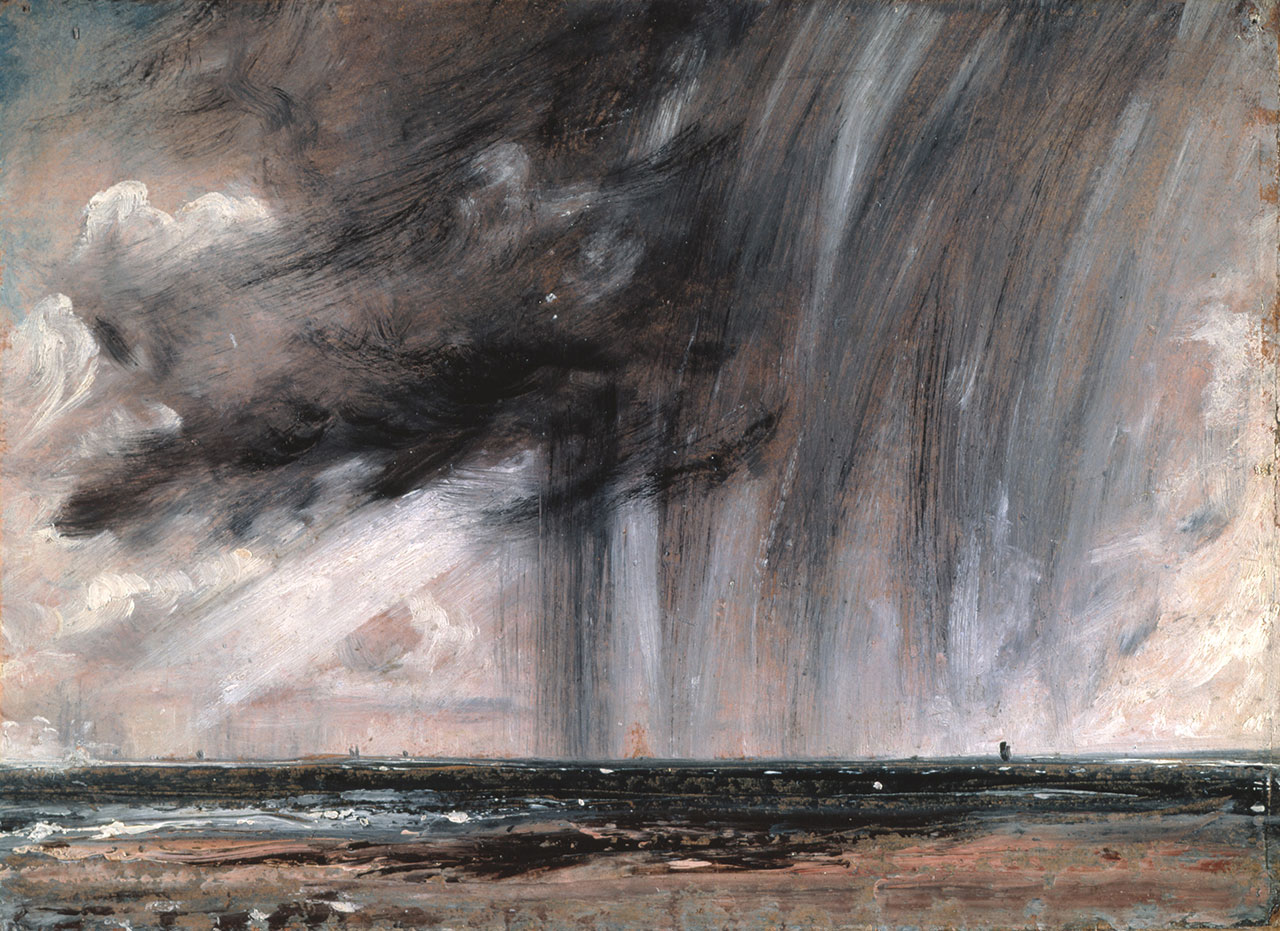
Water in the atmosphere has a major impact on our environment. While it is now recognized as a major scientific, political, and societal issue, it is nevertheless largely overlooked by international law… Led by Laurence Boisson de Chazournes and Thomas Römer, a multidisciplinary team has set out to explore perceptions of and regulations concerning atmospheric water throughout history.
Rain, snow, fog, clouds… Although well known to meteorologists, these subjects of study had, until now, attracted little interest from legal scholars. “In law, atmospheric water is an overlooked concept: there is no legal framework for discussing it , ” explains Laurence Boisson de Chazournes, professor of international law at the University of Geneva and director of the Platform for International Freshwater Law at the Geneva Water Hub. She made this observation in 2023, while holding the Avenir Commun Durable Annual Chair at the Collège de France, which she dedicated to the issue of regulating water use. “This chair allowed me to reflect on blind spots in international law—areas where legal experts lack the tools to effectively support water protection, ” she explains. “And atmospheric water—this ‘unidentified object’ from a legal perspective—represents a major challenge in the current context of the climate crisis and water-related tensions.” Since the main freshwater reservoirs—groundwater aquifers, rivers, and lakes—are increasingly vulnerable, atmospheric water is becoming an increasingly coveted resource. Techniques for harnessing this resource (fog water collection, cloud seeding to trigger precipitation, etc.) are thus attracting growing interest around the world. However, these practices raise not only environmental concerns but also geopolitical ones, particularly the risk of creating new inequalities in access to water.
A Multidisciplinary Team Drawing Insights from the Past
According to Laurence Boisson de Chazournes, it is necessary to propose principles and standards to ensure the proper protection and use of atmospheric water. “But international law cannot undertake this unprecedented exploration on its own. It cannot be separated from beliefs, cultural habits, and the way different cultures view the issue. Water can only be understood through a multidisciplinary approach , ” the legal scholar continues. Together with Thomas Römer, a professor and Chairman of the Collège de France who holds the Chair in The Hebrew Bible and its Contexts, they have both developed a resolutely interdisciplinary initiative. Launched in 2024, the project “Cross-Perspectives on Atmospheric Water” brings together research in international law, ethnography, philosophy, history, religious studies, and theology.
This dialogue between disciplines helps us understand, in particular, that this natural resource has always been at the center of human concerns. “Water ‘that comes from above’ has played an important role in all religions since ancient times,” explains Thomas Römer . Because it is uncontrollable, humans often associate it with the actions of deities: it can be seen as a gift, or as divine punishment when it is scarce or becomes dangerous. “For example, accounts of the Flood appear in a vast number of religious texts—Biblical, Mesopotamian, Maya, Aztec, Hindu… It’s almost a universal myth. There’s always the idea that water can be a weapon of the gods to decimate humanity,” the researche r elaborates . “We also find texts dating back to antiquity that speak of drought, some of which attempt to convince the gods not to punish humanity indefinitely by bringing back the rain. “ From this conception of rain—which can be invoked through prayers or rituals—to a vision of water detached from any belief system, the research team is studying the various human perceptions of atmospheric water throughout history and across different regions of the world.”
From the earliest “rainmakers” to today’s geoengineering practices, has international law never addressed the issue of atmospheric water? Almost never. There was a brief surge during the Cold War, when cloud seeding was developed for military purposes. During the Vietnam War, the U.S. military conducted Operation Popeye from 1967 to 1972, which involved inducing rainfall to prolong the monsoon season and thereby slow the advance of Vietnamese communist troops. This led to international awareness and a swift response aimed at preventing such practices. In 1976, the Convention on the Prohibition of the Use of Environmental Modification Techniques for Military or Any Other Hostile Purposes was adopted. Also known as the “ENMOD Convention,” it applies if it can be demonstrated that the criticized practice involving atmospheric water constitutes an environmental modification for military purposes. “But that’s all we have,” laments Laurence Boisson de Chazournes . “There are no specific regulations concerning the various uses of atmospheric water for peaceful purposes—filling water reservoirs, supporting agriculture, preventing weather-related damage, allocating water for different uses, and so on. This convention plays a negligible role.”
Creating a Legal Framework
So there is still much to be worked out regarding atmospheric water. But the task is daunting: legal experts must take into account numerous legal principles concerning natural resources, as well as the specific characteristics of this water… “International law draws distinctions between airspace, the atmosphere, and outer space. Outer space is regulated to a certain extent by international law, while the rest falls under the sovereignty of states. Should atmospheric water be considered public property, like other bodies of water? However, a large part of the planet is not covered by land and constitutes a common space…,” explains Laurence Boisson de Chazournes. Another challenge lies in the fact that international law treats water in a fragmented manner. The resource is, in fact, divided among its various reservoirs (rivers, lakes, aquifers…), and specific legal rules apply to each of them. Yet, whether groundwater, surface water, or atmospheric water, all forms of water are interdependent and form a single whole: there is a single water cycle. Compounding this oversight is the fact that international law has always approached water from the perspective of its uses. “We have not protected the water resource as such, but rather through the uses we make of it. This raises a question: for atmospheric water, should we approach it through its uses, as has already been done for other types of water, or should we define a legal status for it?” asks the legal scholar.
The researchers are therefore engaged in a pioneering project. Their work began with a process of identification and problem-framing, in order to formalize a legal language concerning this resource—which had not existed until then. It is indeed necessary to find appropriate legal terms to describe atmospheric water, to objectify it, and to distinguish it from other types of water. “This water, which can take the form of vapor, liquid water droplets, or ice crystals, has unique characteristics: its volatility, its mobility, the fact that it circulates very rapidly, and that its genetic nature has not yet been identified…”
Conducting their research from France and Switzerland, as well as in collaboration with Ethiopian researchers, the various project members are in regular contact to share their progress and further their thinking. While an initiative of this scale will require several more years of work, an important milestone awaits the researchers soon: the symposium “The Quest for Atmospheric Water: Historical, Philosophical, Theological, Political, and Legal Issues,” to be held at the Collège de France on October 8 and 9. “This conference is a highlight of the project , ” says Thomas Römer. “It will provide an opportunity to take stock of what has been accomplished in recent years and to bring together the results of everyone’s work . But it will also open up new horizons: we’ve tried to bring together specialists in this field from various disciplines, beyond our own team. This will foster dialogue and, we hope, inspire our young researchers. Perhaps they’ll be able to continue their exploration with these experts and carry the torch forward…” The conference’s contributions and findings will then be compiled into a book. The researchers also hope to share this knowledge through future webinars… But for now, everyone is preparing their presentation for the event, to do their part. “The conference should help clarify certain legal actions or initiatives, or alert certain stakeholders to the possibilities—or limitations—associated with this resource… This is truly research in progress , ” concludes Thomas Römer.