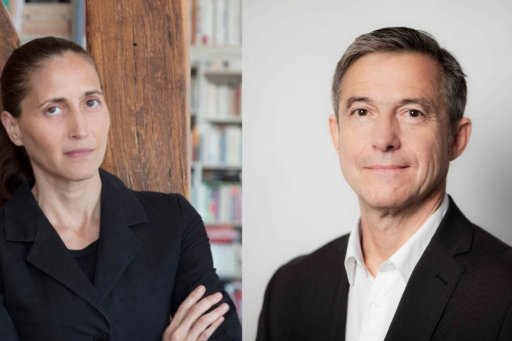
Isabelle Ratié is a specialist in Indian philosophy. She edits Sanskrit texts from manuscripts and translates them. In this way, she traces the history of various little-known currents of thought, and analyzes the complexity of their interrelationships.
In 2025, she became holder of the History of Indian Systems of Thought chair at the Collège de France.
Your research today focuses on Indian philosophy, but you began your career studying Western philosophy. How do you explain this change of trajectory, when your path seemed so clear ?
Isabelle Ratié : Yes, I did study the classics first ! Passionate about Greek philosophy in particular, I obtained a DEA (post-graduate diploma) and was about to embark on a doctorate in this field. Freshly agrégée, I began a career as a high school philosophy teacher... However, one day I came across a book by Guy Bugault, L'Inde pense-t-elle ? It came as a shock to me. I became aware of the existence of a rich and fascinating Indian philosophy. I'd been told since Terminale that philosophy was the prerogative of the West : it was born in Greece around Vthcentury BC and developed in Europe ; its frontiers were wonderfully drawn ! I felt a kind of rage against myself : how could I have refused to question this cliché, when philosophy is precisely a critical exercise of reason ?
So I set out to explore this universe. I soon discovered that good works of synthesis were rare, and that there were few translations of Indian philosophical texts into modern languages. This forced me to intensively learn Sanskrit, and radically change the direction of my studies.
Why is Indian philosophy so little known in the West ?
Indian thought is often summed up in the silence of meditation and mystical experience... This is due to the small number of books and translations available, but not only that. There is a real denial of philosophical India. When Europe first discovered Indian thought, it was first fascinated, then recoiled in horror. At the end of the XIXthcentury and for much of the XXthcentury, Indian thought was considered, often contemptuously, to be solely religious in nature, and in no way philosophic - that is, based exclusively on reason and experience. In reality, Indian thought has developed into systems that bear no resemblance to those of Europe, some of which are undoubtedly philosophical. The encounter with Indian thought, however, overturned the way Westerners had drawn the boundaries between philosophy and religion. When they discovered Buddhism, for example, they found it hard to accept that notions as fundamental to them as the soul or the existence of a creator god could be questioned within a religion..
How do the religious and the philosophical fit together in Indian thought ?
These two realities are distinct, yet function together. The core of the religious sphere is the recognition of a set of Scriptures, words that are authoritative in principle. It is in the recognition of the sacred nature of certain texts that religious identities crystallize. In the first millennium AD, orthodox Brahmins, for example, recognized the authority of the Veda, but the so-called śivaites accepted, alongside or in place of the Vedic authority, that of texts said to emanate from the god Śiva or an associated deity... In medieval India, there was a great diversity of religious currents : orthodox Brahmanism, śivaism, Buddhism, Jainism, Vishnuism... Herein lies India's great paradox, however, for this religious profusion led to a competition that raged in the royal courts. Religious movements competed for the favor of kings and dignitaries. To take part in these oratorical jousts and demonstrate the superiority of their dogmas, each representative had to set aside his or her own Scriptures. After all, no one recognized their opponent's ! Indian philosophy is therefore a neutral space in which the argument of authority has been bracketed, and in which discussion is based on common perception and inferential reasoning - because these are the only universally recognized weapons. Philosophers also wrote a large number of treatises, the structure of which is permeated by this rhetoric of debate. While some religious texts are very old (some parts of the Veda must have been composed around 1200 BC), philosophy as such developed in India later, throughout the first and second millennia AD, with a particular vitality around the middle of the first millennium.
Your work has the specificity and merit of not focusing on a single philosophical school. You study several of them, which enables you to analyze their links..
There is a certain compartmentalization in Indianism. In our studies, we generally specialize in one religious or philosophical current and stick to it... Specialization is a natural and indispensable tendency of any science, but when we seek to understand the systems of thought in India, we have to go beyond these boundaries, because these schools have constantly transformed through contact with each other. I understood this early on in my thesis work, thanks to the śivait authors Utpaladeva and Abhinavagupta, whose works I was studying. In order to demonstrate the superiority of their ideas, they had to take an interest in those of others... And found themselves changed as a result. For example, they mention their Buddhist rival Dharmakīrti a lot: they never stop explaining his thought in order to criticize it, even though they are passionate about it. They adopt whole swathes of his logic and epistemology (his way of defining the different types of inferential reasoning, for example) and borrow his arguments to prove that the world does not exist outside consciousness. Nevertheless, they also transform these arguments in depth : what produces the varied phenomena of which we are aware is no longer with the śivaites, as with Dharmakīrti, a kind of unconscious mechanism in an impersonal series of instantaneous cognitive events, but the creative freedom that is the very essence of all consciousness.
Rather than describing each school of thought separately, in a static, compartmentalized way, it is therefore worth studying the themes on which different thinkers have clashed. In this way, we discover Indian philosophy in the making through the discussions that developed around a controversy - on the nature of the self, of others, of language... I intend to pursue this approach at the Collège de France, already adopted with Vincent Eltschinger in our book Qu'est-ce que la philosophie indienne ?
You mentioned the scarcity of reliable translations of Sanskrit texts. What is at stake in your work as a philologist on these manuscript sources ?
India has long had an important manuscript tradition : over the centuries, scribes, who were often also scholars, constantly recopied and even annotated texts belonging to various genres, including philosophical ones. These scholarly annotations are a marvellous (and as yet little explored) source for the study of India's intellectual history. However, manuscript transmission, even when carried out by great scholars, inevitably leads over time to an accumulation of errors - what is known as manuscript corruption. We are therefore comparing all the sources that are still accessible today in an attempt to find the original text - or rather, because this is only an ideal, to get as close to it as possible. Many manuscripts have come down to us, although many have disappeared, notably because of the climate. They may also have been badly catalogued, or difficult to access for various reasons. Sometimes all that remains are a few fragments of a text, a quotation in another manuscript, by another thinker, in a margin... It also happens that the Sanskrit text cannot be found, but an ancient translation has been preserved, in Tibetan, for example. The advent of digital photography has been a major step forward, saving many extraordinary manuscripts ! Much remains to be discovered, and above all, an enormous amount of publishing work still needs to be done.
What does your appointment to the Collège de France mean to you?
It's still hard for me to realize. I'd never even considered it, firstly because there's never been a woman in this chair before. I've always wanted a career in research, yet it never occurred to me to run for this position... Whereas, for some of the gentlemen at this institution, it was a boy's dream, a possible destiny from childhood. I also feel very privileged, to the point of feeling guilty towards my colleagues at the university. I know how difficult their working conditions are : today's lecturers are overwhelmed by administrative tasks that rob them of the time they should be able to devote to research.
In 1814, the Collège de France created the first Sanskrit chair in Europe. Its title has sometimes changed (to include other Indian languages, or to focus more on history than languages), and it has been occupied by extraordinary scholars such as Eugène Burnouf, Sylvain Lévi and Jean Filliozat. It's very intimidating to follow in the footsteps of all these great researchers. I'm going to spend the rest of my career trying to deserve this frightening honor ! I'm also very happy for my discipline, which is seeing this Indianist chair revived : its last occupant, Gérard Fussman, left in 2011. I see it as a way of bringing Indianists together. I want to create opportunities for people working on India, whatever their field and wherever they come from, to meet and talk to each other. It promises to be a wonderful exchange.
Interview by Salomé Tissolong, journalist